A quadratic spline joins polynomial pieces of degree two into one path. Each piece can be quadratic, while joining conditions keep the overall path continuous and smooth. Splines turn scattered points into controllable curves for games, graphics, GIS, engineering, and manufactured surfaces. section 7.0
A practical construction starts with a straight segment, then creates each later quadratic piece by borrowing the tangent vector from the previous segment. This lets a path pass through newly added points while preserving smooth motion. section 7.2.2
The construction exposes useful controls:
- Adjust tangent length to change the curve’s appearance without changing its waypoints. section 7.2.2
- Choose a speeding/slowing coefficient k to govern how early or late the path turns. section 7.2.2
- Continue adding points while retaining a smooth, continuous, governable path. section 7.2.2
Changing the turn
Two paths can pass through the same points but behave differently: k = 0.8 makes the boat tend to turn early, while k = -1.5 makes it tend to turn late. section 7.2.2
Figure 7.13 The path goes through the same points, but with k = 0.8, the boat tends to turn early, and with k = 1.5, it tends to turn late.
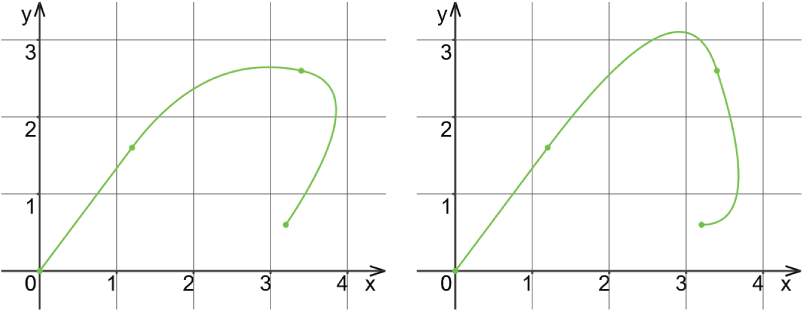
Compare paths through identical waypoints and see how changing k alters their turning behavior. section 7.2.2
