A denoising model transforms a noisy representation toward a cleaner representation or generated output. In diffusion, the same model runs repeatedly, removing a little noise at each step. section 17.2.2
Rather than predicting a finished image, the model can predict a noise mask and subtract it from the input. A noise-rate input tells it how much noise to extract. section 17.2.2
A U-Net denoising model typically combines:
- Downsampling convolution blocks that reduce a 128 × 128 image to a smaller feature map. section 17.2.2
- A middle stage that preserves the feature-map size. section 17.2.2
- Upsampling blocks paired with the downsampling blocks, plus concatenative residual connections that preserve image detail. section 17.2.2
Text-guided image generation
A text-to-image pipeline tokenizes prompts, creates text embeddings, progressively denoises pure noise into an image, and rescales the output from [-1, 1] to [0, 1]. The denoising model receives positive and negative prompt representations. section 17.3.1
Figure 17.9 Our U-Net style denoising autoencoder architecture
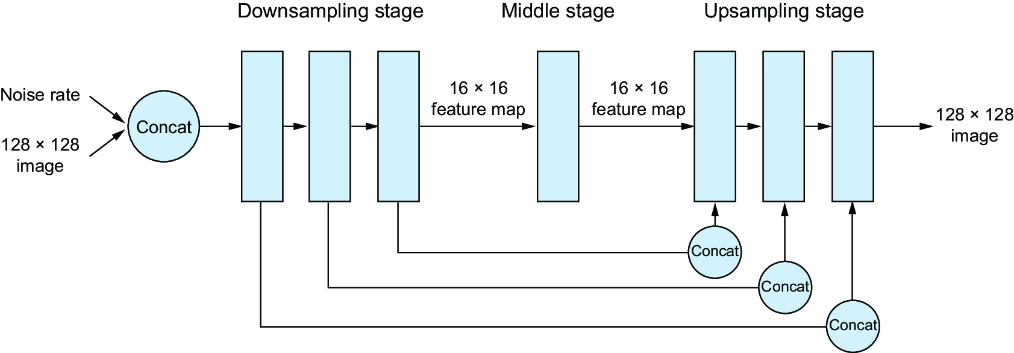
Use the architecture figure to trace the U-Net’s downsampling, middle, upsampling, and skip-connection structure. section 17.2.2
