The shortcut rule says that optimizing one success metric produces solutions tailored to that goal, often sacrificing qualities the metric does not measure. In AI, high task performance therefore does not necessarily indicate general intelligence. section 19.3.3 section 19.5
The Netflix recommendation challenge
The winning system optimized movie-prediction accuracy, but Netflix did not use it because its complexity and compute demands outweighed its practical value. Accuracy improved while inference cost, maintainability, and explainability suffered. section 19.3.3
Chess is not human intelligence
DeepBlue defeated Garry Kasparov in 1997, yet building a chess champion revealed little about human intelligence. Its success depended on alpha–beta search rather than the broad capabilities researchers had hoped chess would require. section 19.3.3
A single metric can leave important system properties unoptimized:
- Operational cost, including inference compute. section 19.3.3
- Maintainability and explainability. section 19.3.3
- Adaptation to novelty and broader generalization. section 19.5
Figure 19.8 A low-generalization system can achieve arbitrary skill at a fixed task given unlimited task-specific information.
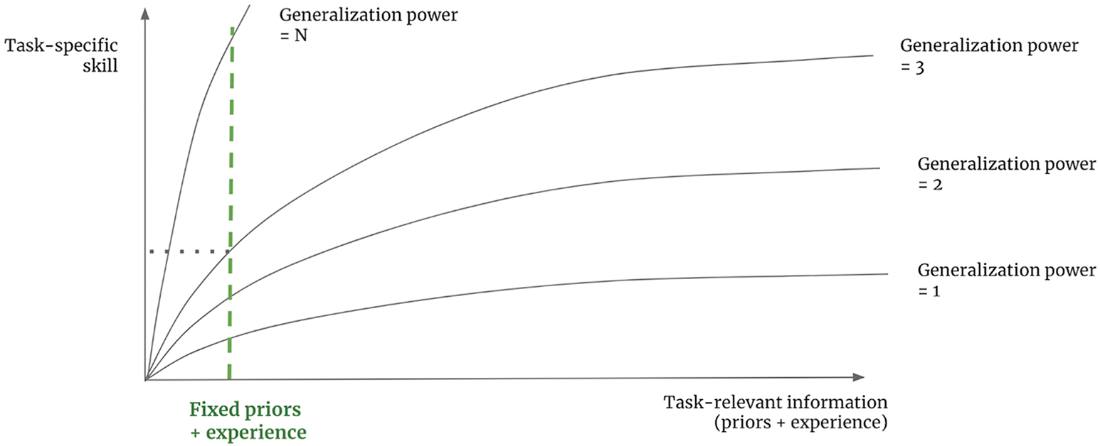
Use the figure to see how unlimited task-specific information can produce arbitrary skill on a fixed task without broad generalization. section 19.3.3
