Keptn Lifecycle Toolkit is a cloud-native lifecycle orchestration toolkit for deployment observability, deployment-data access, and deployment-check orchestration. It also provides mechanisms to check workloads and act when problems occur. section 9.3
Keptn extends the Kubernetes Scheduler to monitor workloads and extract deployment information. Teams define custom pre- and post-deployment tasks with Keptn TaskDefinition resources. section 9.3
Configure lifecycle monitoring through standard Kubernetes metadata and task hooks:
- Annotate services with application name, logical grouping, and version metadata. section 9.3
- Enable the lifecycle toolkit on a namespace with kubectl annotate ns default keptn.sh/lifecycle-toolkit="enabled". section 9.3
- Attach a post-deployment task through keptn.sh/post-deployment-tasks and execute inline Deno code with deployment context. section 9.3
Conference application lifecycle hook
The Agenda service uses Kubernetes annotations to identify the service and its application grouping. A notifications service can attach a stdout task that receives workload name, application name, workload version, task type, and object type after deployment. section 9.3
Figure 9.21 Keptn architecture providing out-of-the-box observability and application lifecycle hooks.
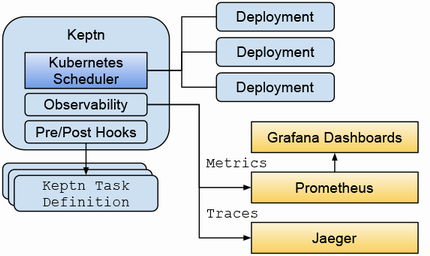
Use the architecture diagram to trace how observability and application lifecycle hooks extend Kubernetes deployment workflows. section 9.3
