A GPU kernel is a small program or function that runs on a parallel processor to perform a computation. In deep learning, optimized kernels coordinate threads, registers, and shared memory so operations use the chip efficiently. section 6.1.1
Kernel tuning selects and orders suitable implementations from optimized libraries rather than relying on arbitrary code execution. The best choice depends on the GPU, input and filter sizes, tensor layout, batch size, and neural-network architecture. section 6.1.1
Practical implications:
- Benchmark multiple kernel choices because the fastest implementation varies with hardware and tensor shapes. section 6.1.1
- Treat tuning as part of model compilation and deployment optimization, not merely as a code-level change. section 6.1.1
Figure 6.2 An example of an unoptimized network compared to the same network optimized using graph optimization. CBR is a NVIDIA fused layer kernel that simply stands for Convolution, Bias, and ReLU. See the following NVIDIA blog post for reference: https://mng.bz/PNvw.
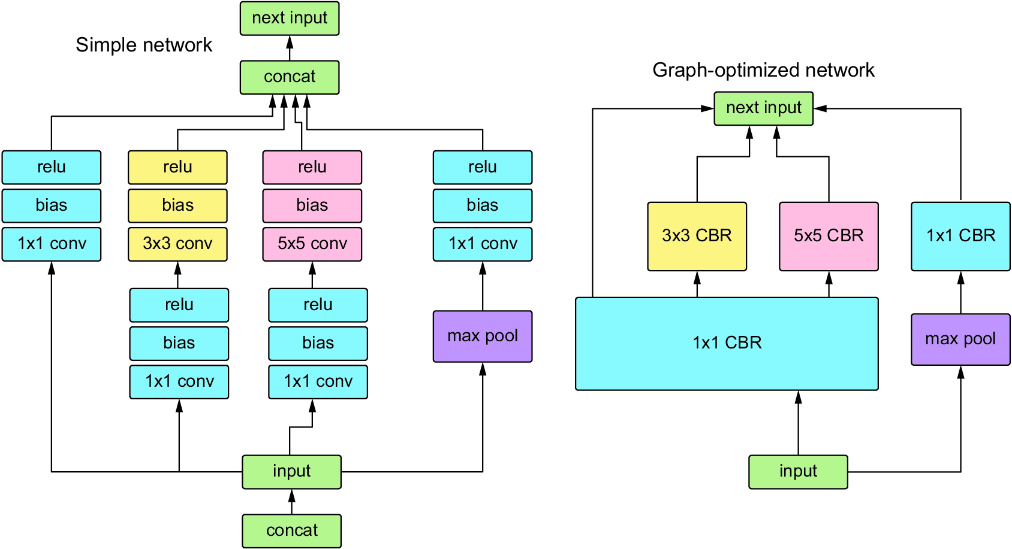
Visualizes graph optimization by contrasting an unoptimized network with fused convolution, bias, and ReLU kernel operations. section 6.1.1


