A key management service (KMS) administers and controls cryptographic keys used to encrypt and decrypt protected data. In Atlas, enabling KMS integration is part of the customer’s initial security configuration, alongside Bring Your Own Key (BYOK), identity management, network connectivity, auditing, and backup settings. section 20.1
Use KMS with awareness of the shared operational boundary:
- Configure the encryption integration and select the relevant cloud-provider security settings during initial deployment. section 20.1
- Treat ongoing enforcement as a platform responsibility: Atlas maintains encryption at rest and in transit, authentication, network isolation, auditing, and backups after setup. section 20.1
- Retain the required customer-managed key and IAM credentials when restoring managed backup snapshots; KMS integration makes them necessary for restores. section 21.1.1
KMS-backed backup restore
Atlas managed snapshots are encrypted automatically. When integration with AWS KMS, Azure Key Vault, or GCP KMS is enabled, restoring a snapshot requires the corresponding customer-managed key or service-account key and IAM credentials. section 21.1.1
Figure 20.1 The shared responsibility model in Atlas divides security and operational tasks among customers, MongoDB, and the underlying cloud providers (AWS, GCP, and Azure). (Image © MongoDB 2024 CC BY-NC-SA 3.0)
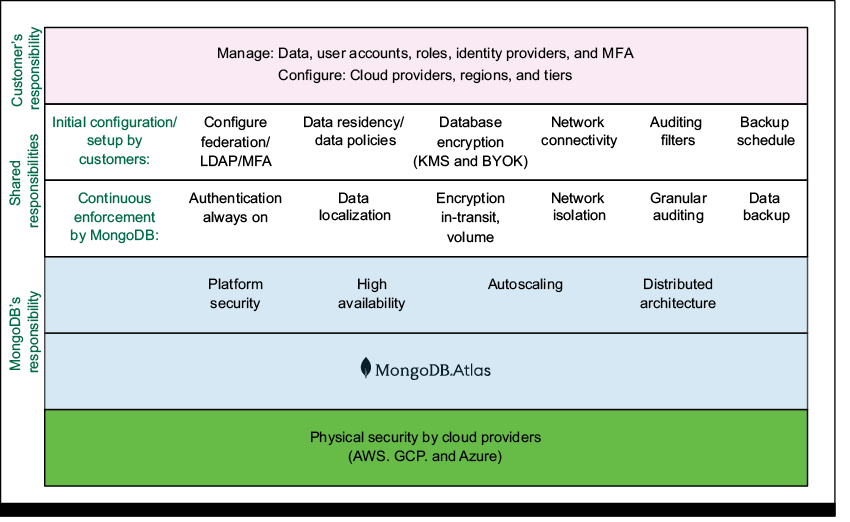
Use the shared responsibility model to distinguish customer configuration of KMS and BYOK from Atlas’s continuing enforcement of encryption and other security controls. section 20.1
