A particle is one candidate solution in particle swarm optimization. Its position locates it in the feasible search space, while its velocity describes how it moves. Particles combine their own experience with information from the swarm to search for better solutions. section 9.2 section 9.2.1
A particle’s behavior combines three influences:
- Inertia preserves movement from the previous step and supports the balance between exploration and exploitation. section 9.2.1
- The cognitive component pulls the particle toward its personal best position, using its own past experience. section 9.2.1
- The social component guides it toward the swarm’s best position, or toward a neighborhood best in a divided swarm. section 9.2.1
- Each iteration updates velocity first, then adds the new displacement to position. section 9.2.1
The bird-flocking analogy makes the idea concrete: particles resemble birds, fish, or bees that move through a space while responding to individual and collective success. Their decentralized interactions produce coordinated search without requiring one agent to control the whole swarm. section 9.2
Particle representation for a TSP
For a traveling-salesman problem, a particle represents a candidate city ordering. Because ordinary velocity and direction do not naturally apply to permutations, velocity becomes a sequence of city swaps. Redefined multiplication changes the number of swaps, subtraction derives swaps between two positions, and addition applies swaps to create a new tour. section 9.4
Figure 9.3 Visualizing the motion equation for a particle in the swarm
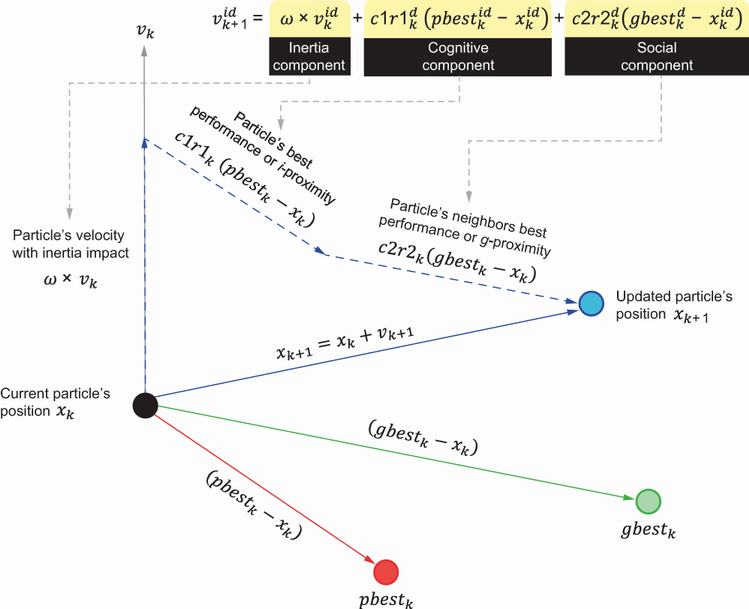
Use the motion-equation figure to trace inertia, cognitive attraction, social attraction, velocity, and position as vectors in two dimensions. section 9.2.1
