When poisoned threat intelligence begins freezing accounts across a customer base, a kill switch provides a broader runtime stop than a single circuit breaker. It can block new actions, revoke tool access, cancel in-flight work where safe, or isolate the affected workflow. Completed actions remain completed and require separate compensating or recovery actions. section 1.3
A kill switch is an architectural guardrail that halts or contains autonomous execution when conditions exceed defined safety bounds. Unlike an agent’s own reasoning, it remains enforceable when that reasoning is wrong. It complements automation’s stable routines with runtime controls for systems that perceive, decide, and act. section 1.2.2
Use the control at explicit runtime boundaries:
- Stop new tool calls or business actions when an affected workflow exceeds its permitted scope. section 1.3
- Revoke access to tools or isolate the workflow when credentials, inputs, or decisions become unsafe. section 1.3
- Pair broad stop controls with circuit breakers, rate limits, policy checks, and confidence thresholds rather than treating one mechanism as sufficient. section 1.3 section 1.2.2
Fraud-account freeze cascade
A fraud agent consumes a poisoned threat-intelligence feed and starts freezing accounts across the customer base. A circuit breaker on the freeze-account API can stop the cascade early; a kill switch can additionally revoke tool access or isolate the workflow. Any freezes already completed need separately designed recovery actions. section 1.3 section 1.5.1
Figure 1.5 Autonomy across architectural layers, showing how each layer acquires a runtime governance dimension without replacing existing structures.
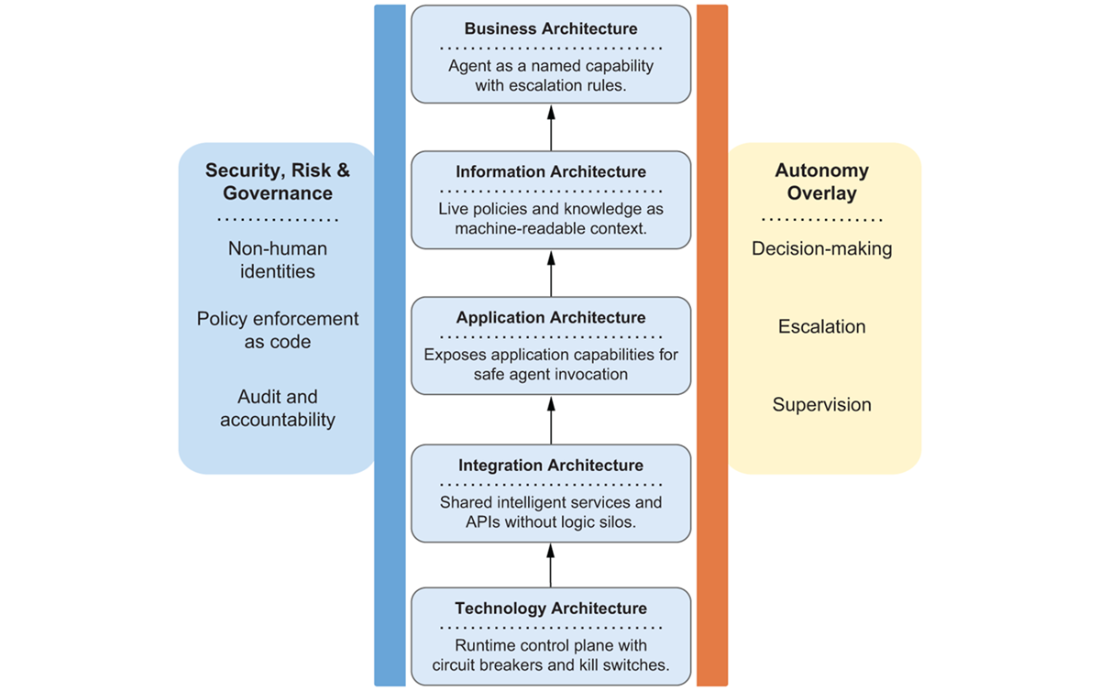
Use the architectural-layer view to locate kill switches alongside integration contracts, technology controls, security identities, and governance responsibilities. section 1.5.1

