liveBook · Manning

Knative Configuration

As explained in Google Anthos in Action

A Knative Configuration is a custom resource that declares the desired configuration of a workload independently from its container code.

Knative Configuration is a custom resource that declares the desired configuration of a workload separately from its container code. It belongs to Knative Serving’s resource model, alongside Service, Revision, and Route: changing the configuration creates a new immutable Revision, while Routes expose revisions to users. section 9.3.2

Use Configuration to:

  • Separate application configuration from the container image. section 9.3.2
  • Trigger a new Revision when configuration changes. section 9.3.2
  • Rely on a Knative Service to create and manage the related Configuration, Revision, and Route resources. section 9.3.2

Deployment relationship

Applying a Knative Service manifest with a container image and environment variable creates multiple objects, including a Configuration and Revision. You can inspect them with kubectl get pod,ksvc,configuration,revision,route. section 9.3.6
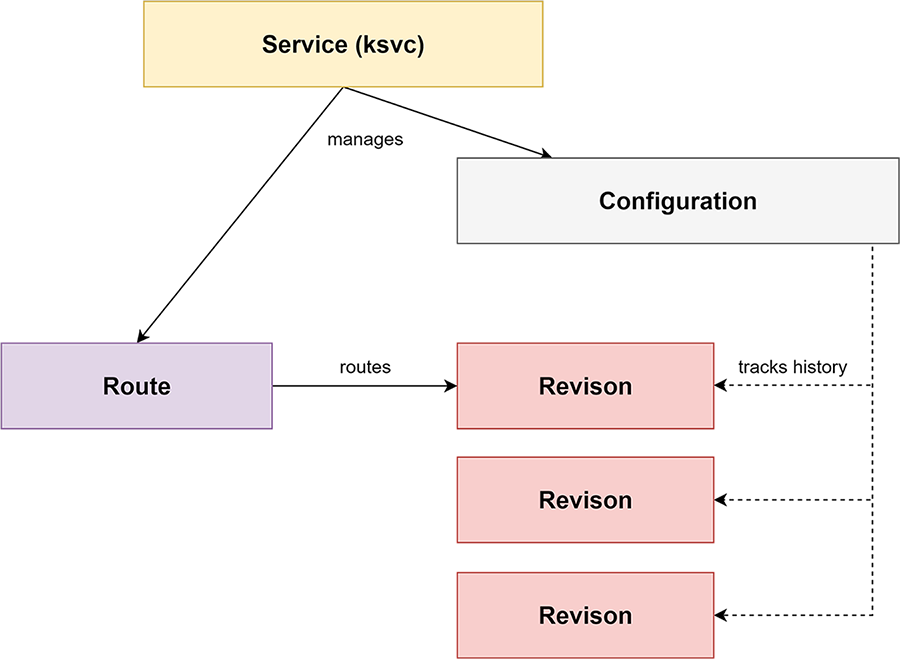
Figure 9.4 Knative Serving resources
09-04

Inspect the resource dependency diagram to see how Configuration fits into Knative Serving’s Service, Revision, and Route lifecycle. section 9.3.2

How Google Anthos in Action covers it

How deep it goes
Defines desired state and revision creation, but does not detail the resource schema or controller internals.
Examples
Uses a container image, environment variable, applied Service manifest, and kubectl resource inspection.
What it assumes
Assumes a containerized application and an available Knative deployment; demonstrates deployment with a Python image stored in Docker Hub.
What you can do after
Operate/configure Knative workloads by applying Service manifests and verifying generated Configuration and Revision resources.
How it connects
Connects Knative Service, Revision, Route, Kubernetes, containers, and HTTP-based serverless workloads.

Related concepts

This explainer was generated by Manning's knowledge graph from the text of Google Anthos in Action. The section links point to the parts of the book it draws on.