Knowledge acquisition collects information from data sources, the environment, or domain experts and converts it into structured or implicit knowledge for reasoning. In advisory intelligent systems, it extends an established, domain-specific knowledge base using evidence and feedback from suggested actions. section 2.2.3 section 2.3
The acquisition pipeline differs by representation:
- Knowledge graphs transform raw, structured, or semistructured data into entities, relationships, and properties guided by ontologies or schemas. Domain experts identify sources, shape the data model, and evaluate results. section 2.3
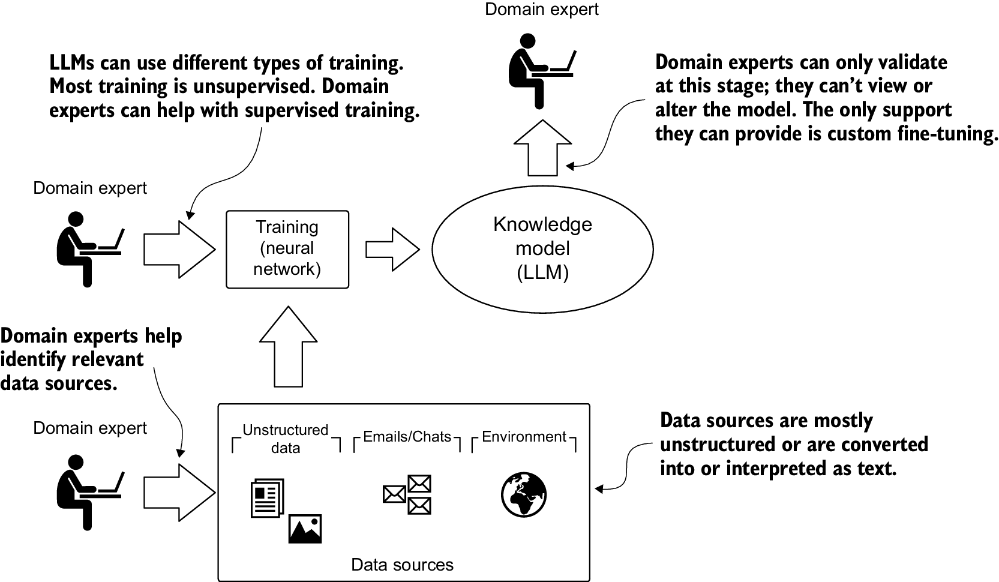
- LLMs ingest large collections of unstructured text, encode information as statistical patterns in dense vector spaces, and rely mainly on source selection and cleaning. Their representations capture context but are opaque and difficult to modify. section 2.3
- Hybrid systems combine explicit graph knowledge for structured reasoning with language-model interpretation for ambiguity, context, and incomplete information. section 2.7
Figure 2.6 Knowledge acquisition for KGs: converting available data into an explicit knowledge representation through structured entities, relationships, and properties. This process involves a domain expert who identifies relevant data sources, supports the data model, and evaluates the results.
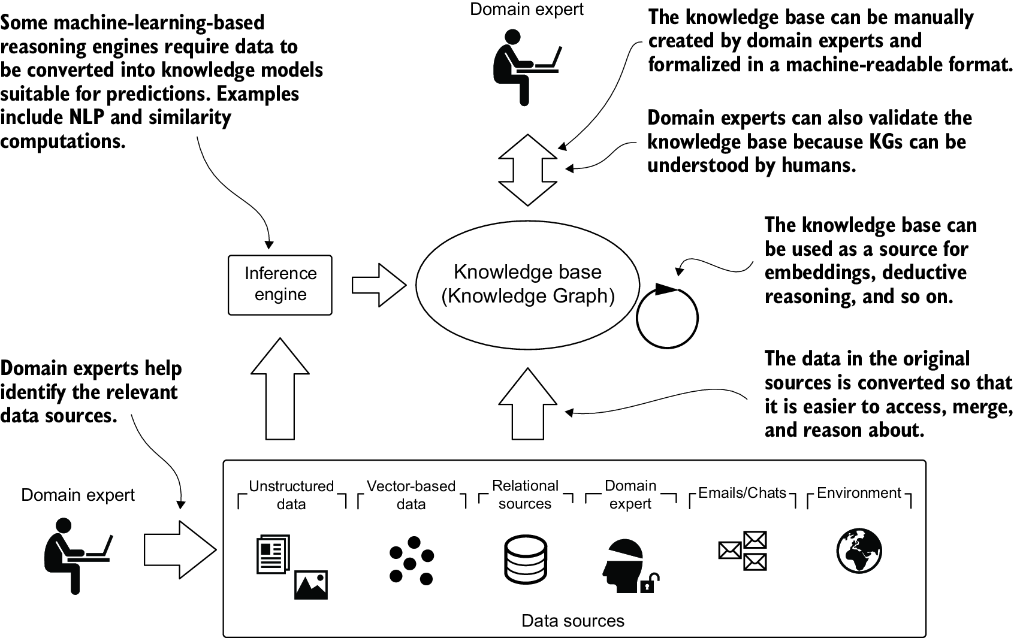
Shows the knowledge-graph pipeline from source identification and data modeling through explicit representation and expert evaluation. section 2.3
