liveBook · Manning

Knowledge factor

As explained in Acing the CCNA Exam: Volume 2 Advanced Networking and Security

A knowledge factor is an authentication factor based on information that the claimant knows.

A knowledge factor is an authentication factor based on something the claimant knows, such as a password, PIN, or security-question answer. section 11.3.2

Use these distinctions when classifying authentication methods:

  • Passwords, PINs, and security-question answers are knowledge factors. section 11.3.2
  • A password and PIN together still provide only one factor category because both are something the user knows. section 11.3.2
  • Possession factors include badges, smartphones, and authenticator applications; inherence factors include biometric scans. section 11.3.2

Password plus SMS code

A username and password provide a knowledge factor. An SMS code delivered to the user’s smartphone adds a possession factor, making the combination multifactor authentication. section 11.3.2
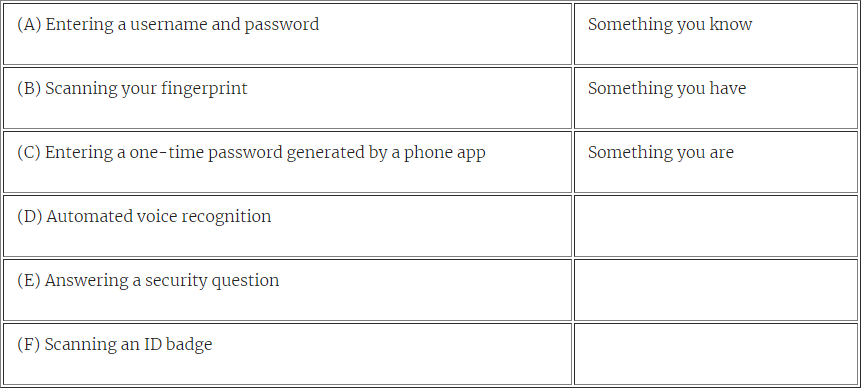
Review the authentication-method classification exercise for exam-style identification of knowledge, possession, and inherence factors. section 11.5.2

How Acing the CCNA Exam: Volume 2 Advanced Networking and Security covers it

How deep it goes
Defines the category, lists representative methods, and explains why combining two knowledge factors does not constitute true MFA.
Examples
Uses passwords, PINs, security questions, and username-password authentication paired with an SMS code.
What it assumes
Assumes only the basic idea of user authentication and teaches the three factor categories from their defining properties.
What you can do after
Evaluate authentication methods and identify whether an MFA design combines distinct factor categories.
How it connects
Connects knowledge factors with multifactor authentication, possession factors, inherence factors, passwords, and PINs.

Related concepts

This explainer was generated by Manning's knowledge graph from the text of Acing the CCNA Exam: Volume 2 Advanced Networking and Security. The section links point to the parts of the book it draws on.