Knowledge graph embedding maps entities and typed relationships in a heterogeneous graph into low-dimensional vectors. It uses directed triples—head, relation, tail—so relationship labels distinguish connection types, unlike approaches that encode only nodes. section 11.1.1 section 11.4
A triple such as Ana —LIVES_IN→ Paris records both endpoints and the relationship type. Triples support graphs with many entity and relationship types, although the embedding representation does not explicitly define node labels. section 11.1.1
TransE gives an intuitive embedding rule: for a valid triple, the head vector plus the relation vector should lie close to the tail vector (h + r ≈ t). Training favors this pattern for known triples and keeps nonexistent head–relation–tail combinations apart. section 11.1.2
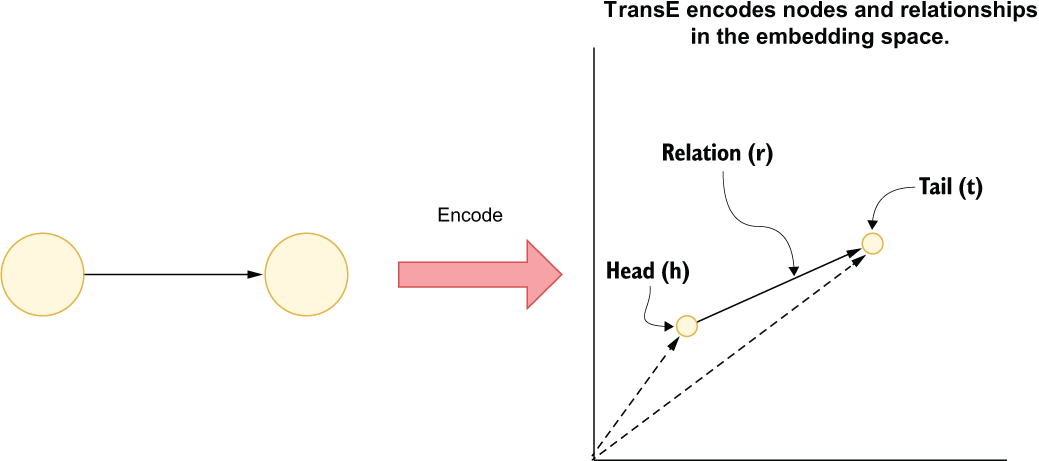
Use the diagram to see a relationship represented as a vector translation from a head entity toward its tail entity. section 11.1.2
A practical completion workflow is:
- Start with a rich knowledge graph containing known entities, relationships, and their types. section 11.2
- Train an embedding model to encode entities and relationships, then rank likely missing links and their types. section 11.2
- Treat predictions as candidates for review rather than approved conclusions. section 11.4
Drug repurposing
A biomedical graph of drugs, diseases, genes, pathways, and known treatments can be embedded to suggest new applications for aspirin. Supporting literature and existing graph paths help domain experts assess a prediction; clinical trials remain necessary for approval. section 11.2 section 11.2.5 section 11.4
