A Kafka prototype can run brokers that serve messages, but a production cluster also needs a reliable way to track topics, partitions, broker health, and leadership. KRaft (Kafka Raft) is Kafka’s metadata-management mode: a controller quorum maintains cluster state internally rather than relying on a separate ZooKeeper cluster. Brokers handle client traffic; controllers coordinate the cluster. Depending on the configuration, a server may perform either or both roles. section 1.3.2 section 9.0 section 9.1.4
The controller quorum makes metadata changes and detects failures:
- The active controller records changes such as topic creation, partition assignments, and broker registrations in a metadata log. Follower controllers replicate the log; an update is committed after a majority acknowledges it. section 1.3.2 section 9.1.1
- Brokers send heartbeats to the active controller. If one stops responding within the configured timeout, the controller can treat it as failed. If the active controller fails, a healthy controller can be elected to replace it. section 1.3.2
- Clients obtain metadata through brokers, not by reading the controller log. Brokers can keep a local, read-only metadata copy for faster access and startup. section 9.1.1
Figure 9.2 Metadata updates are sent to the leader controller, which appends each update to its log. Follower controllers fetch these updates from the leader, and once a majority have replicated the update, it is marked as committed.
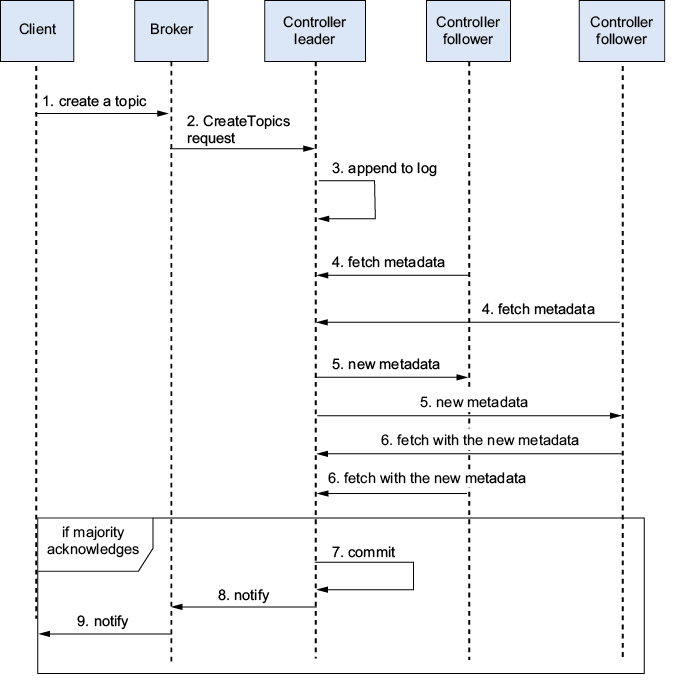
Follow one metadata update from the leader controller to its followers; majority replication is the point at which the update becomes committed. section 9.1.1
Planning for a data-center outage
A controller placement that loses its majority when one data center goes down cannot continue leader elections or metadata changes. Distributing controllers across three data centers can preserve quorum through a complete outage of one. More generally, tolerating N controller failures requires 2N + 1 controllers, leaving a majority of N + 1. section 9.1.1 section 9.5
KRaft changes operational planning, not just where metadata is stored. Size and place controllers for the failures the cluster must survive, and account for controller behavior in monitoring and incident plans. For an older ZooKeeper-based cluster, migration is an architectural upgrade: Kafka 4.0 requires ZooKeeper’s removal, and the surrounding Kafka components must be checked for compatibility before upgrading. section 9.0 section 9.5 section 11.1

