Control authority is the ability of a specification to direct system change. It exists when a behavior change is expressed in the specification before it reaches implementation: an agent can read the specification, plan from it, build from it, and validate against it. A specification that is updated only after code changes may describe the system accurately, but it did not steer that change. section 3.5.1
A small edit with a larger cost
Suppose an access rule changes. Editing the code directly may produce the right behavior, but it leaves the specification out of the decision. Updating the specification afterward restores its accuracy without restoring its authority over that change. Future work must recover the intended rule from code, review comments, prompt history, or memory. The specification-first alternative is to state who is allowed and who is refused before changing the implementation. section 3.5.1 section 3.5.2
Authority alone is not enough. A specification can drive every change yet leave decisions open to improvisation: “validate input” does not identify invalid input, and “redirect” does not define observable proof that redirection worked. This is a failure of specification fidelity, not of the change sequence. Conversely, a specification reconciled after implementation may be faithful to the current system while leaving code as the real control surface. section 3.5.2
Figure 3.5 How alive a specification is depends on the control authority and fidelity.
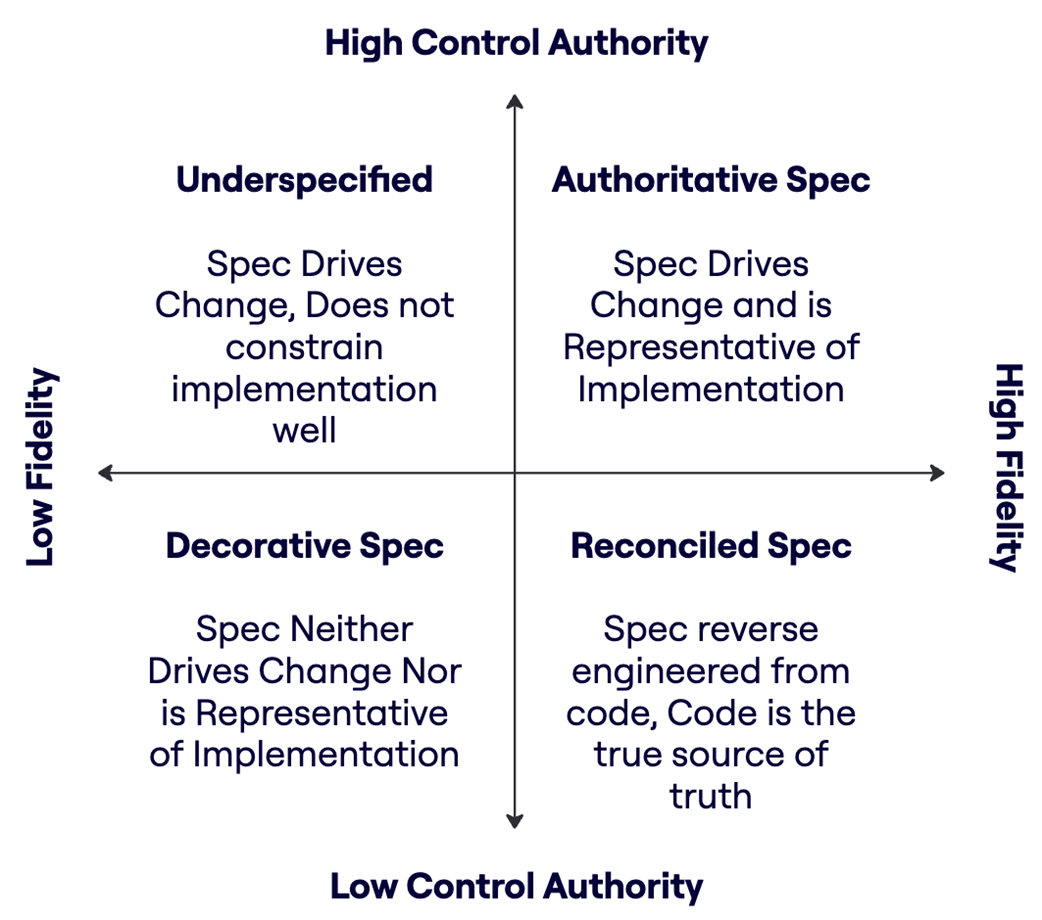
Use the authority–fidelity matrix to distinguish a specification that both drives and constrains change from one that is underspecified, merely reconciled with code, or neither authoritative nor faithful. section 3.5.3
The operational test is not whether a specification exists or was recently edited. Ask whether changing it still steers the next implementation change, and whether it says enough to constrain that change. Preserve both properties by fixing the specification before the code and checking the result against the stated intent. section 3.5 section 3.5.3