An intent harness sits above an execution harness. Rather than asking a coding agent to implement an idea and correcting it as it goes, humans and agents use structured dialogue to turn that idea into durable intent artifacts. Those artifacts shape the context in which the coding agent implements and validates a change. The artifact—not the generated code—is the primary control surface. section 1.4 section 2.4
Spec-driven development is one approach within the intent harness. Specification authoring makes intent precise enough to guide implementation and verify the outcome. A completed specification remains available as context for later features, rather than disappearing with the conversation that produced it. Autonomous iteration workflows offer a complementary approach, using governing constraints to steer repeated execution. section 2.2 section 1.8
Rebuilding a URL shortener
In a conversational coding pass, the developer asks for the URL shortener, inspects the agent’s output, and repeatedly corrects it; much of the intent remains in the session. A spec-driven pass articulates the target before implementation. The resulting specification guides the agent’s implementation and validation and remains as context when the application gains another feature. section 2.4
Treat the harness as a workflow that can fail and improve:
- When an implementation gap escapes, inspect where intent was lost: surfacing, capture, construction, or verification. section 3.4 section 3.7
- Repair the relevant part of the workflow with better questions, richer formats, stronger constraints, or deterministic evidence. Move recurring guidance into standing context and checks instead of repeating it in every feature specification. section 3.7
Figure 2.1 A mental model of SDD's role as part of the intent harness to elicit intent and operationalize it as specifications to engineer context for the execution harness.
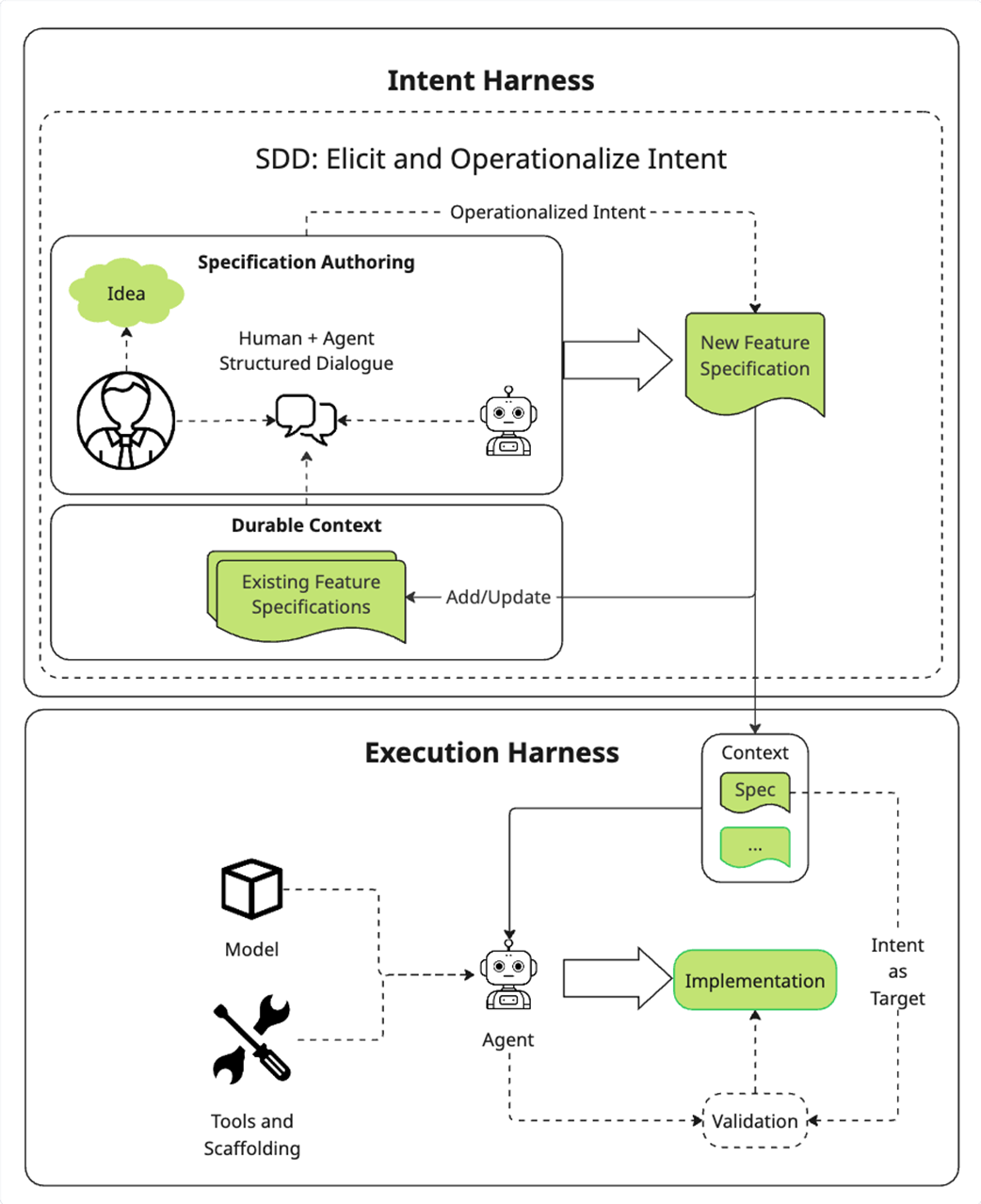
The diagram locates spec-driven development within the intent harness and shows how specifications become context for the execution harness. section 2.2