A Kubernetes manifest is a YAML configuration document that declares an application's desired state, potentially combining resources such as a namespace, Deployment, and Service. Applying one file lets Kubernetes create the resources and record the last applied configuration, making deployment changes easier to manage and track. section 3.2.4
A manifest coordinates several deployment responsibilities:
- Defines workload settings, including the container image, replica count, labels, selectors, and Pod template. section 15.4.3
- Groups related resources in one declarative artifact instead of requiring separate imperative commands. section 3.2.4
- Captures migration-specific configuration alongside generated Docker images, persistent volumes, and custom resource definitions when produced by Migrate for Anthos. section 15.3.2 section 15.4.3
Applying a generated deployment manifest
A Migrate for Anthos workflow generates deployment_spec.yaml containing a Deployment with one replica and a migrated container image. After installing the runtime, apply it with `kubectl apply -f deployment_spec.yaml`; Kubernetes creates the workload, and `kubectl get pods` can confirm that the Pod is running. A separate Service manifest can expose the workload through a LoadBalancer.
Prefer manifests for repeatable deployments and configuration tracking. Imperative commands can create the same result quickly, but they may not expose every resource option; any emergency changes should be recorded back in the declarative manifest. section 3.2.4
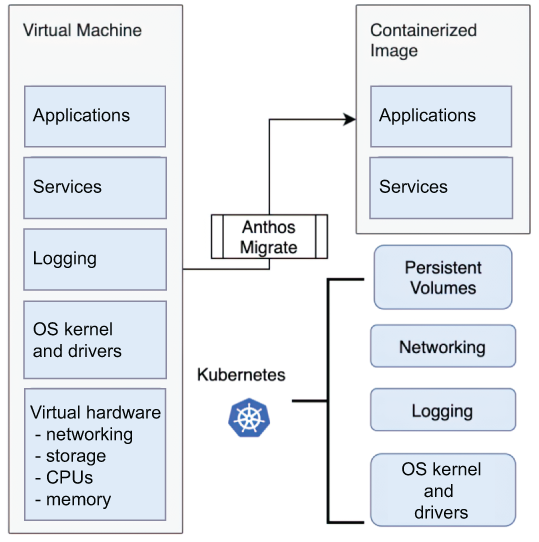
Use the migration architecture figure to see how deployment YAML moves application configuration and persistent storage from a VM into Kubernetes-managed components. section 15.3.2