L1 regularization supports feature selection by shrinking model coefficients. When a feature is not relevant to the target variable, its coefficient can be reduced to zero, effectively removing that feature. section 11.3.3
Use L1 regularization as an embedded feature-selection approach, while keeping its practical tradeoffs in view:
- Pair it with Lasso regression to select features through an embedded model. section 11.3.3
- Treat it as a middle ground between filter and wrapper methods in computation and selection quality. section 11.3.3
- Prefer faster rough cutoffs for initial pruning when many features are obviously useless or hardware is limited. section 11.3.3
Lasso removes features
As the L1 regularization term grows, Lasso regression reduces coefficients to zero one by one, producing a smaller feature subset. section 11.3.3
Figure 11.9 Lasso regression eliminates features one by one by reducing their coefficients to zero as L1 regularization term grows.
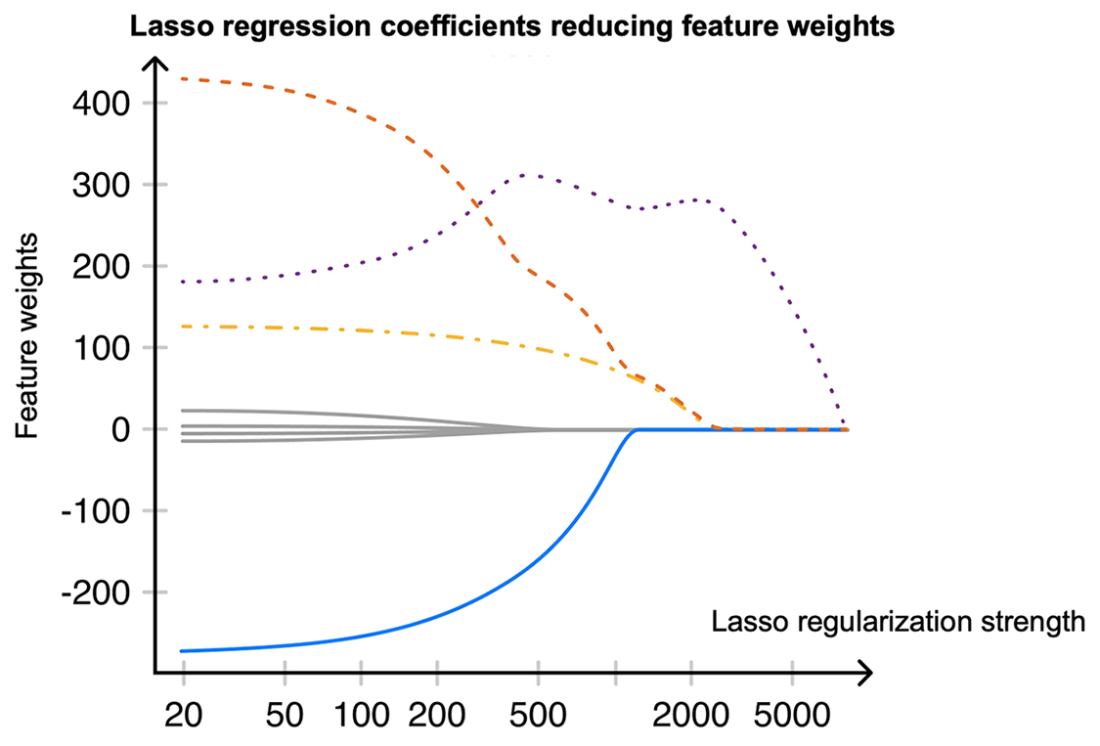
Shows how increasing the L1 term eliminates features by driving their coefficients to zero. section 11.3.3







