In object detection, label confidence is the model’s confidence that an object’s class is correct—for example, that a detected object is a bicycle rather than a person. It does not necessarily indicate whether the object’s bounding box is accurate; many detection algorithms return a label-confidence score but no localization-confidence score. section 6.1.1
Use label confidence to identify predictions that may need human review:
- Apply least confidence, margin or ratio of confidence, entropy, or an ensemble to the model’s label probability distribution. section 6.1.2
- Sample the bounding boxes with the greatest uncertainty for human review. For label accuracy, use a variation on F-score or AUC; assess bounding-box localization separately with intersection over union (IoU). section 6.1.1 section 6.1.2
Figure 6.3 An example prediction heat map for an object, showing low variation (left) and high variation (right). The high variation is evidence of more uncertainty in the model; therefore, the right example is a good candidate for human evaluation. You can generate multiple predictions by using ensemble models, getting predictions from multiple models and changing the parameters, using a subset of features or a subset of items, or introducing random variation into your models in some other way. Within a single model, you can generate multiple predictions for a single item by using a dropout over a random selection of neurons for each prediction (known as Monte Carlo dropouts). You can also combine both methods: create an ensemble of models, and use dropouts for multiple predictions per model.
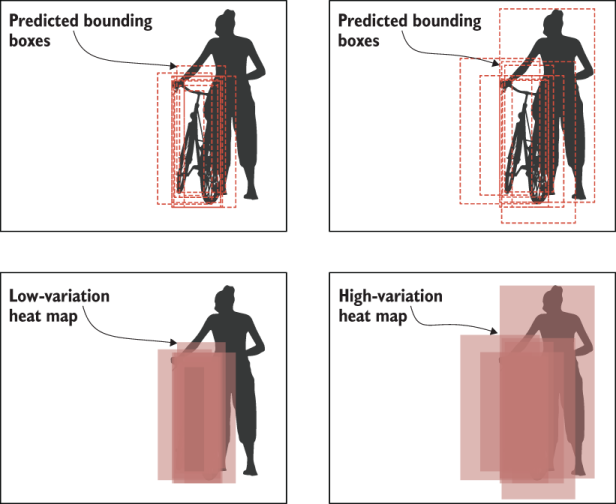
Compare low- and high-variation object predictions: greater variation signals greater uncertainty and a stronger candidate for human evaluation. section 6.1.2