Lag-Llama is an open-source foundation model for zero-shot probabilistic time-series forecasting. It predicts a distribution of future values rather than a single point forecast, allowing prediction intervals to be selected from the output. section 4.1 section 4.6
Its decoder-only architecture is based on LLaMA. Tokenization combines lagged series values over a context window with date-time features, while a distribution head produces future values autoregressively. The model assumes a Student’s t-distribution for its predictions. section 4.1.1 section 4.1.2
Figure 4.1 General architecture of Lag-Llama. It features only the decoder portion of the transformer architecture; the distribution head is responsible for generating the distribution of future values.
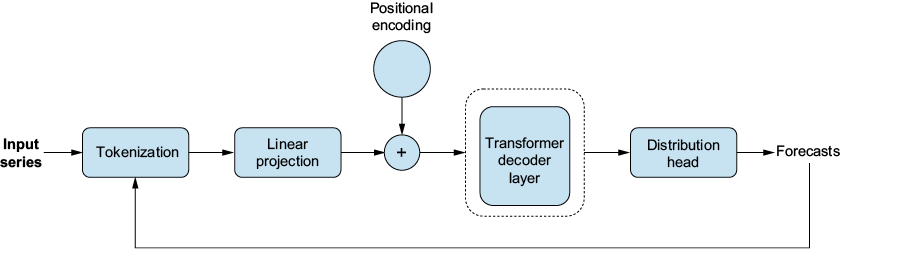
Use the architecture diagram to follow tokenization, linear projection, decoder attention, distribution generation, and autoregressive feedback. section 4.1.1
Important operating constraints shape when Lag-Llama is a practical choice:
- Handles one univariate series at a time and does not accept exogenous features. section 4.0
- Was pretrained on daily, hourly, 15-minute, and 1-minute data, but not weekly, monthly, or quarterly data. section 4.1.2
- Usually performs best over horizons of 24 to 60 time steps; longer horizons may reduce prediction quality. section 4.1.2
- Requires cloning the repository, installing dependencies, downloading weights, and using GluonTS for inference rather than a packaged Python API. section 4.2 section 4.3.1
Local inference and fine-tuning setup
A practical setup loads lag-llama.ckpt, selects a device, sets prediction_length and context_length, constructs a LagLlamaEstimator, and fine-tunes with parameters such as lr=5e-4, batch_size=64, and max_epochs=50. A context length of 64 is used after producing the best observed performance in the exercise. section 4.3.1
Figure 4.2 Tokenization process in Lag-Llama. Here, the token of the current time step includes lagged values of the series over a certain context length, as well as date-time features.
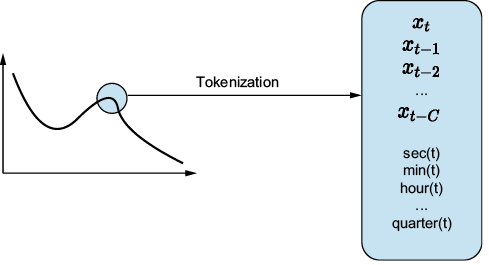
Use the tokenization figure to inspect how each token combines a context of lagged values with date-time features at multiple frequencies. section 4.1.1
