A lakehouse catalog is the coordination layer between Iceberg storage and compute engines. It registers tables, organizes namespaces, resolves metadata, governs access, and coordinates updates so multiple tools share consistent table state. section 2.7.3 section 7.1
Figure 2.6 Components of a complete data lakehouse implementation
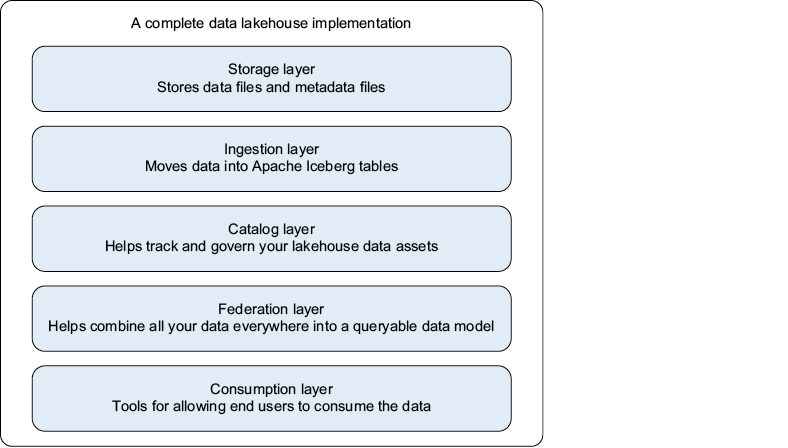
Use the lakehouse component diagram to place the catalog between object storage, ingestion, federation, and consumption. section 2.7
A catalog performs four core responsibilities:
- Registers tables and resolves names into current metadata locations. section 7.1.1
- Associates table identifiers with schemas, partition specifications, manifests, snapshots, and other metadata objects. section 7.1.1
- Groups tables into namespaces that support discovery, organizational boundaries, and access control. section 7.1.1
- Coordinates optimistic transactional commits and rejects conflicting updates rather than allowing race conditions. section 7.1.1
Query and processing engines consult the catalog first: they resolve a table, load its metadata, plan against a snapshot, and submit updates atomically. The same metadata view supports schema evolution, time travel, rollback, data skipping, and predicate pushdown across Spark, Flink, Trino, Dremio, and other engines. section 7.1.2 section 7.1
Catalog availability and latency sit on the critical path of reads and writes. Production evaluation should therefore consider request throughput, concurrent commits, namespace growth, fault tolerance, replication, failover, and the ability to scale metadata services without creating a bottleneck. section 7.2.1
The catalog is also becoming the lakehouse security control plane. It can centralize namespace- and table-level RBAC and vend short-lived, scoped storage credentials, while row- and column-level controls remain incompletely standardized and may still require engine or storage enforcement. section 7.6
Selection criteria include:
- Require Apache Iceberg REST Catalog support when engines and orchestration tools need standardized metadata access; verify read and write support separately. section 4.3.3
- Match deployment choices to governance, compliance, operational ownership, cloud strategy, scalability, and future multicloud or hybrid requirements. section 7.7
- Compare options such as Nessie, Apache Polaris, AWS Glue Data Catalog, Apache Gravitino, Lakekeeper, Hive Metastore, and REST-compatible services rather than defaulting to legacy familiarity. section 2.7.3 section 4.4.3
Local Nessie catalog integration
A Docker Compose environment can combine Nessie for catalog tracking, MinIO for S3-compatible storage, Spark for ingestion, Dremio for SQL, PostgreSQL as an operational source, and Superset for dashboards. Configure Dremio with the Nessie endpoint, warehouse path, storage credentials, and S3 compatibility properties; Dremio then detects the Iceberg tables registered in Nessie. Leave authorization disabled only for a simple local exercise; production deployments should enable appropriate governance. section 3.2 section 3.4.2 section 3.2.3
