A language branch is a subdivision within a language family containing more closely related languages that developed from common ancestors. In a hierarchy, branches sit between language families and individual language leaves. section 11.0
Represent a language branch as an intermediate node in a hierarchical visualization:
- Place the root node, such as Languages, above language families. section 11.0
- Connect each family to its language branches, such as Germanic, Indo-Aryan, Romance, and Sinitic. section 11.0
- Terminate branches with language leaves, then use links, labels, and node styling to make the hierarchy readable. section 11.3 section 11.3.2
Five-language hierarchy
Indo-European divides into Germanic, Indo-Aryan, and Romance: English belongs to Germanic, Hindi to Indo-Aryan, and Spanish and French to Romance. Sino-Tibetan divides into Sinitic, containing Mandarin Chinese. section 11.0
Figure 11.2 A hierarchical visualization has one single root that separates into one or more branches. It ends with leaf nodes, which in this example are the languages.
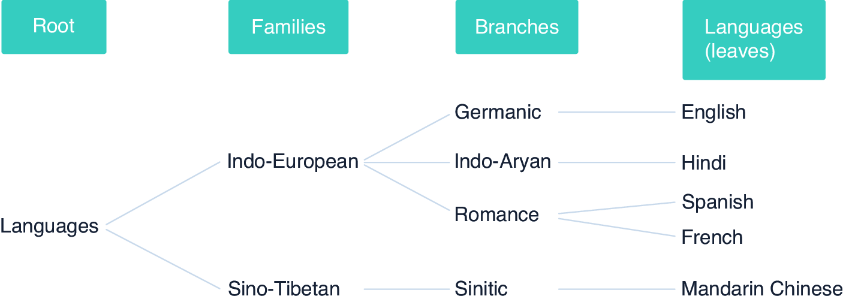
Use the hierarchy diagram to inspect how the root, language families, language branches, and language leaves form parent-child levels. section 11.0
Figure 11.10 Partial view of the tree chart that we’ll build in this section
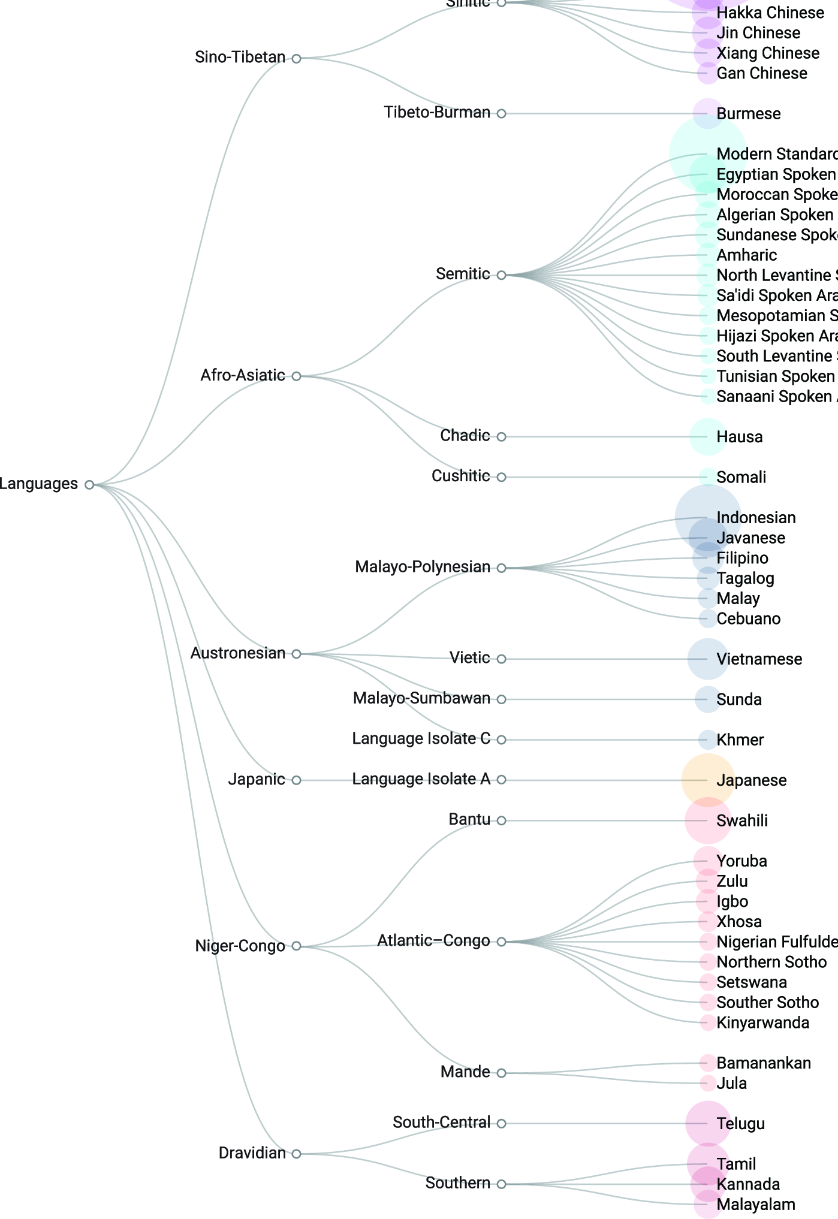
Use the tree-chart view to see language branches positioned between families and languages, with links expressing their relationships. section 11.3
