Language flexibility lets applications using different programming languages, library versions, operating systems, and package managers run on one container platform. Containers remove dependence on fixed deployment-system requirements, so teams can update packages without being trapped by outdated platform dependencies. section 1.1.1
Containers provide flexibility by isolating application environments:
- Run different versions of Java or other dependencies without shared libraries causing configuration conflicts. section 1.1.1
- Use different base operating systems and package managers, such as Ubuntu with APT or CentOS with RPM. section 1.1.1
- Combine services maintained by separate teams, even when those services use different languages or dependencies. section 1.1.1
Mixed application stack
A single host can run several containers: one application may use Java and one dependency version, while another uses a different language, base OS, and package manager. Their isolated environments prevent one configuration from interfering with another. section 1.1.1
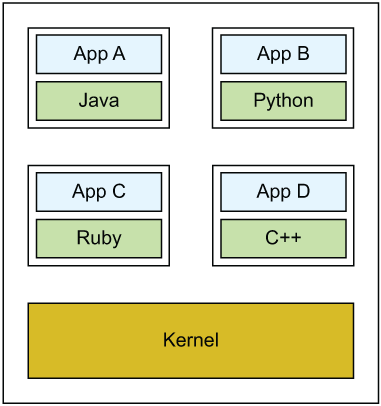
Compare how containers using different languages share one host while keeping their application environments separate. section 1.1.1
