Evolutionary deep learning (EDL) combines evolutionary computation with deep learning to automate and optimize model development. It is a broad family of patterns rather than one algorithm: evolutionary search can operate on data and features, hyperparameters, validation and selection, network architecture, or network weights. section 1.0 section 1.1 section 1.3.1
Use EDL when conventional development leaves difficult search choices or when a complex problem needs further optimization. Evolutionary methods explore candidate solutions through search patterns that can uncover alternative strategies or architectures; they can also replace backpropagation for direct parameter search. The trade-off is substantial computation, so simpler systems may not justify the cost. section 1.1 section 1.2 section 6.0
Common EDL applications include:
- Hyperparameter optimization, with random and grid search serving as non-evolutionary baselines before PSO, evolutionary strategies, or differential evolution. section 5.0
- Neuroevolution for hyperparameters, network parameters or weights, and network optimization; direct weight search can eliminate error backpropagation. section 1.6 section 6.0
- Architecture and model-workflow optimization, including tuning network size and form, feature engineering, validation, and model selection. section 1.3.1
- Specialized tasks such as discontinuous weight search, balancing generative adversarial networks, and replacing deep reinforcement learning. section 1.2
From baseline search to neuroevolution
A practical path starts by manually tuning a network, then establishes random and grid-search baselines. Evolutionary methods can next search its hyperparameters. For direct neuroevolution, construct a simple NumPy multilayer perceptron, evolve network parameters instead of propagating loss backward, then extend the approach to a Keras model and image classification. section 5.0 section 6.0
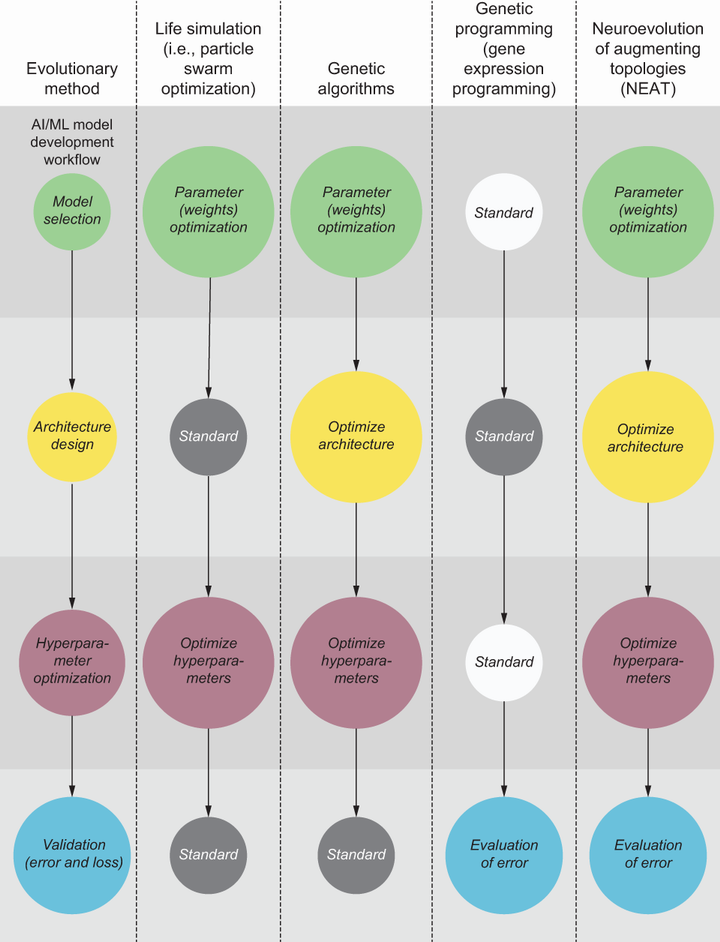
Maps evolutionary-computation strategies onto stages of the AI/ML development workflow, clarifying that EDL can automate more than network training. section 1.5
