Instinctual learning (IL) is an abstract model for using evolution to develop generalized machine-learning behavior. An instinct is a core learned behavior: it may emerge through evolution, or through reinforcement and repeated practice until a response becomes automatic. IL uses that transition as a design pattern for digital agents that reuse behavior across tasks. section 12.3 section 12.3.1
The motivating analogy is dual-process thought. A slower, conscious, trial-and-error process resembles system 2; with sufficient conditioning, its behavior can become a fast system-1 response. IL treats this shift from learned behavior to reusable instinct as a starting point rather than a complete theory of generalized intelligence. section 12.3.1
An IL-style implementation separates task-specific parts from reusable behavior:
- Represent candidate behaviors as functions, operators, or network-layer blocks that can be selected and evolved. section 12.0 section 12.6
- Keep input and output layers specific to each environment while sharing middle-layer instinct slots. section 12.6
- Evaluate an individual across multiple environments, then evolve layer choices toward a shared instinct pool. section 12.6
- Allow reused functions to be mixed and matched, while constraining where they may appear in the network. section 12.6
Shared instincts in a DQN agent
A pair of DQN networks can solve two environments with separate environment-facing layers and three shareable middle-layer slots. A candidate gene sequence selects layer blocks for each agent; the selected blocks are assembled with the Keras functional API, evaluated across environments, and evolved. The setup demonstrates generalization by seeking a shared base set of behaviors, not by making every layer identical. section 12.6 section 12.7
IL is exploratory and deliberately simplified. Breaking a DQN into instincts can demonstrate cross-task reuse, but generalized digital life and broadly generalized ML remain difficult goals rather than guaranteed outcomes. section 12.3.1 section 12.7
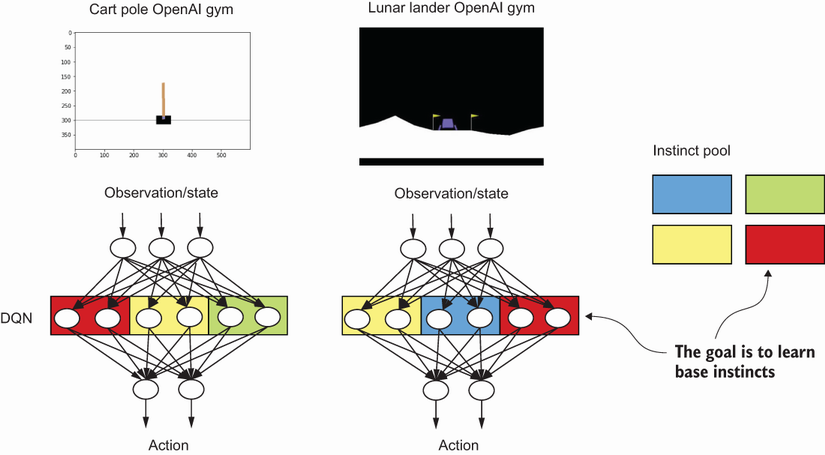
This diagram shows the central architectural move: two DQN agents retain environment-specific edges while drawing from shareable instinct slots in their middle layers. section 12.6
