A confidence gate is a metacognitive control that stops an agent from presenting low-certainty results as facts. It distinguishes knowing from generating and makes uncertainty visible when evidence or knowledge is incomplete. section 10.1.1
Unlike ordinary reasoning, which can improve answers to well-defined problems, a confidence gate addresses whether the agent knows enough to answer. It matters when the problem is ambiguous, evidence conflicts, or the agent lacks relevant data. section 10.1.1
A practical confidence-gate response follows this pattern:
- Detect low confidence, contradictory signals, or a knowledge boundary before presenting an answer. section 10.1.1 section 10.3.7
- Withhold unsupported claims instead of turning a plausible guess into a fact. section 10.1.1
- Provide partial information, explicitly mark uncertain claims, and suggest next steps. section 10.3.7
- Record the boundary encounter so later queries in the same area can trigger earlier uncertainty signals. section 10.3.7
When the agent has no data
An agent asked about an unknown topic may generate a plausible answer. A confidence gate instead recognizes its lack of data, marks the available claims as uncertain, gives partial information if possible, and recommends what the user should do next. section 10.1.1 section 10.3.7
Figure 10.1 The five production agent failure modes mapped to cognitive and metacognitive deficits
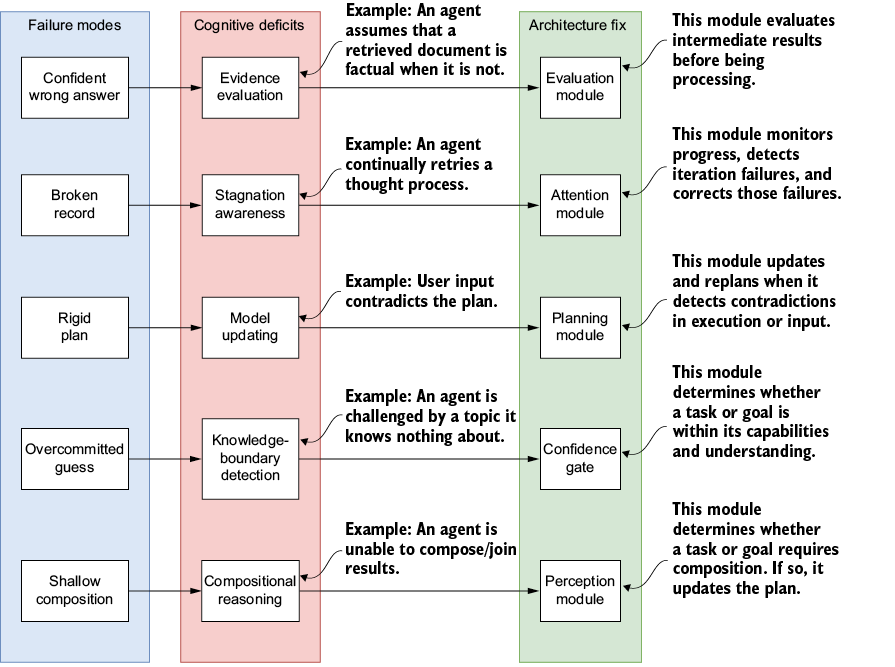
Maps the confidence gate to the production failure mode in which capable agents guess instead of recognizing uncertainty. section 10.1.1
