Lazy evaluation delays computing an expression until another operation needs its value. It avoids unnecessary function calls and can prevent large inputs from being processed when only a subset is required. JavaScript normally evaluates eagerly, computing an expression as soon as it is bound, whether or not the result is used. section 7.2
Generating only what take needs
Suppose range produces many numbers and take reads only the first few. Eager evaluation runs range completely, then discards most of its output. Lazy evaluation waits until take requests values, so range produces only the required elements. The same issue appears with Maybe.of(student).getOrElse(createNewStudent()): JavaScript eagerly calls createNewStudent even when student is present. A conditional branch avoids that needless call. section 7.2 section 7.2
In JavaScript, functional code can approximate lazy behavior in two practical ways:
- Use an alternation combinator so a fallback function runs only when the first function returns a falsy result, as in findStudent followed by createNewStudent. section 7.2
- Use a Lodash chain with map, filter, and take; shortcut fusion defers the chain until value is requested and can stop after three results. section 7.2
- Treat a function chain as a deferred program: an enrollment chain filters students, extracts grades, averages them, and executes at value(). section 1.3
Figure 7.6. The composition of the function range (returns a list of numbers from beginning to end) with take (reads the first n elements). In eager evaluation, the range function executes completely, feeding its result to take. With lazy evaluation, the result of range never executes until the dependent operation, take, is called.
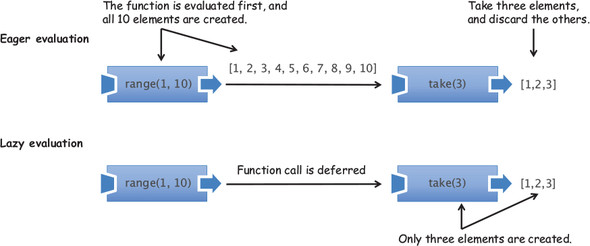
Compare eager range execution, which creates the full list before take runs, with lazy execution, which waits for take and produces only needed values. section 7.2
Lazy evaluation is an optimization, not a universal improvement: functional code can sometimes be slower or use more memory than imperative code. Use it when avoiding unused work matters, and distinguish it from memoization, which caches results after evaluation. section 7.5












