A cryptographic implementation can reveal secrets through its behavior, not just its outputs. Leakage-resilient cryptography addresses this threat with software mitigations intended to reduce information exposed through side channels such as power use, execution time, or cache activity. section 13.4
A power trace reveals a private key
An RSA square-and-multiply implementation performs multiplication only for set bits of the private exponent. Because multiplication consumes more power, a single power trace can expose the exponent's bits and potentially the private key. section 13.4
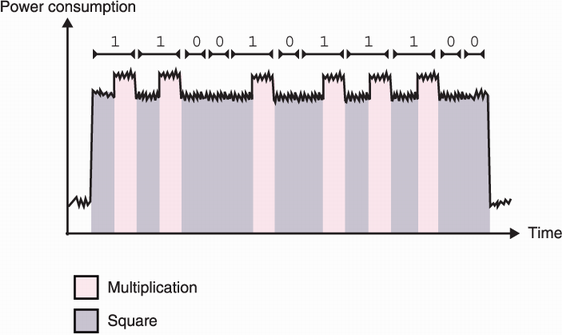
Figure 13.5 Some cryptographic algorithms leak so much information via their power consumption that a simple power analysis of a single power trace (a measure of the power consumed in time) can leak the private key of the algorithm. For example, this figure represents a trace of an RSA exponentiation (the message being exponentiated to the private exponent; see chapter 6). The RSA exponentiation is implemented with a square-and-multiply algorithm that iterates through the bits of the private exponent; for each bit it applies a square operation followed by a multiply operation only if the bit is set. In this example, multiplication is obviously consuming more power; hence, the clarity of the power trace.
Use the power-trace figure to see how visibly different operations can turn an implementation's physical behavior into key-revealing evidence. section 13.4
