liveBook · Manning

Learning to configure algorithms

As explained in Optimization Algorithms: AI techniques for design, planning, and control problems

A machine-learning approach that selects or tunes parameters of an optimization algorithm.

Learning to configure algorithms uses machine learning to enhance a combinatorial optimization algorithm by supplying useful parameter values rather than formulating solutions directly. section 11.5

Typical learned parameters include:

  • Learning rate or step size in gradient descent. section 11.5
  • Initial temperature or cooling schedule in simulated annealing. section 11.5
  • Gaussian mutation standard deviation or selective crossover in genetic algorithms. section 11.5
  • Inertia, cognitive, and social coefficients in particle swarm optimization, or evaporation and desirability influences in ant colony optimization. section 11.5
Figure 11.14 Machine learning (ML) for combinatorial optimization (CO) problems
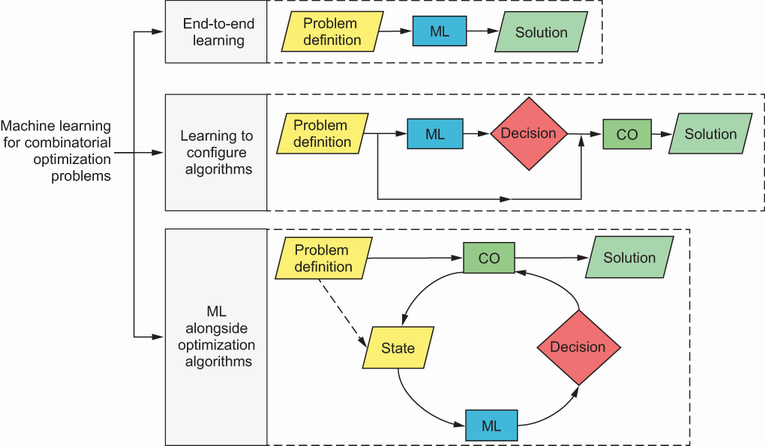
Compare algorithm configuration with end-to-end learning and repeated ML-assisted decision-making for combinatorial optimization. section 11.5

How Optimization Algorithms: AI techniques for design, planning, and control problems covers it

How deep it goes
Defines parameterization and contrasts it with direct solution formulation and repeated model consultation, without detailing training procedures.
Examples
Uses learning rates, cooling schedules, mutation variation, crossover selection, swarm coefficients, evaporation, and pheromone desirability as examples.
What you can do after
Apply machine learning to parameterize an existing combinatorial optimization algorithm.
How it connects
Connects machine learning with gradient descent, simulated annealing, genetic algorithms, particle swarm optimization, and ant colony optimization.

Related concepts

This explainer was generated by Manning's knowledge graph from the text of Optimization Algorithms: AI techniques for design, planning, and control problems. The section links point to the parts of the book it draws on.