A green build does not mean a team understands the code or that its specification covers every failure. The own phase turns verified work into code the team can understand, maintain, and accept accountability for. It follows exploration, specification and planning, and task-level implementation and verification. section 1.3 section 1.4.1
Refactoring is the handoff from working code to owned code, not cosmetic cleanup. A human takes an unfamiliar solution apart and reworks it in the team’s terms, using that process to uncover subtle mistakes. An agent can do much of the mechanical work, but the human directs it and remains responsible for the result. section 1.3
To make ownership more than a final green build:
- Rework the implementation until the team can understand and maintain it in its own terms. section 1.3
- Keep asking what the executable specification and its verification gates do not say; passing tests cannot establish that all failures have been considered. section 1.4.1 section 1.5
- Capture relevant intent, constraints, and decisions rather than leaving essential context only in people’s heads. section 1.4.1
A contract can miss real input
An ISBN validation prompt omitted that real inputs can contain spaces and approximated the intended official specification. A model could follow the prompt while missing the engineer’s intent. Ownership means revisiting what the contract leaves unstated, even when generated tests appear broad. section 1.4.1
Figure 1.1 The vibe engineering loop carries a feature from open-ended exploration through an executable specification and an iterating verification gate to tested, team-owned code.
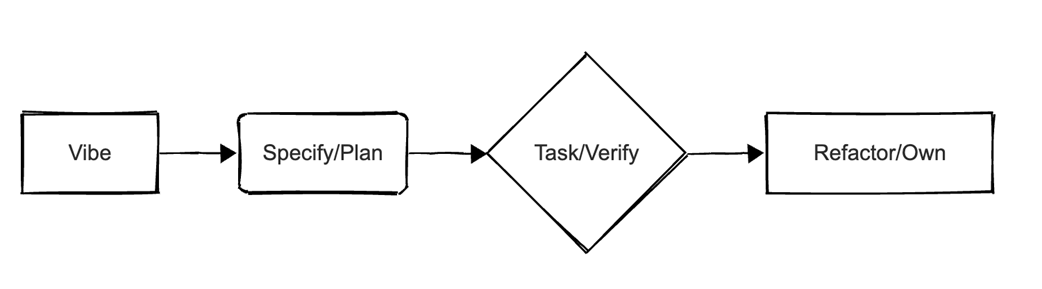
The loop shows ownership after exploration, specification, and verification, rather than treating a passing gate as the endpoint. section 1.3
