Lexical binding creates an accessibility boundary by associating symbols with values inside surrounding parentheses. A binding remains available throughout its lexical scope without being re-evaluated. section 3.1
Clojure local bindings differ from imperative assignment in several important ways:
- Treat let as syntactic sugar for invoking an anonymous function with immutable parameters. section 3.1
- Prevent mutation: a bound symbol has no storage location and cannot later produce a different value. section 3.1
- Allow shadowing, where a later binding reuses a symbol without changing the earlier binding. section 3.1
- Pass successive local bindings between loop iterations instead of mutating a loop variable. section 3.4
A let binding and its function equivalent
The local symbols a and b exist only inside the expression surrounded by let: (let [a 1 b 2] (* (+ a b) b)) ;; 6. The equivalent anonymous-function form is ((fn [a b] (* (+ a b) b)) 1 2). section 3.1
Figure 3.1. Lexical scope for locally bound symbol "b".
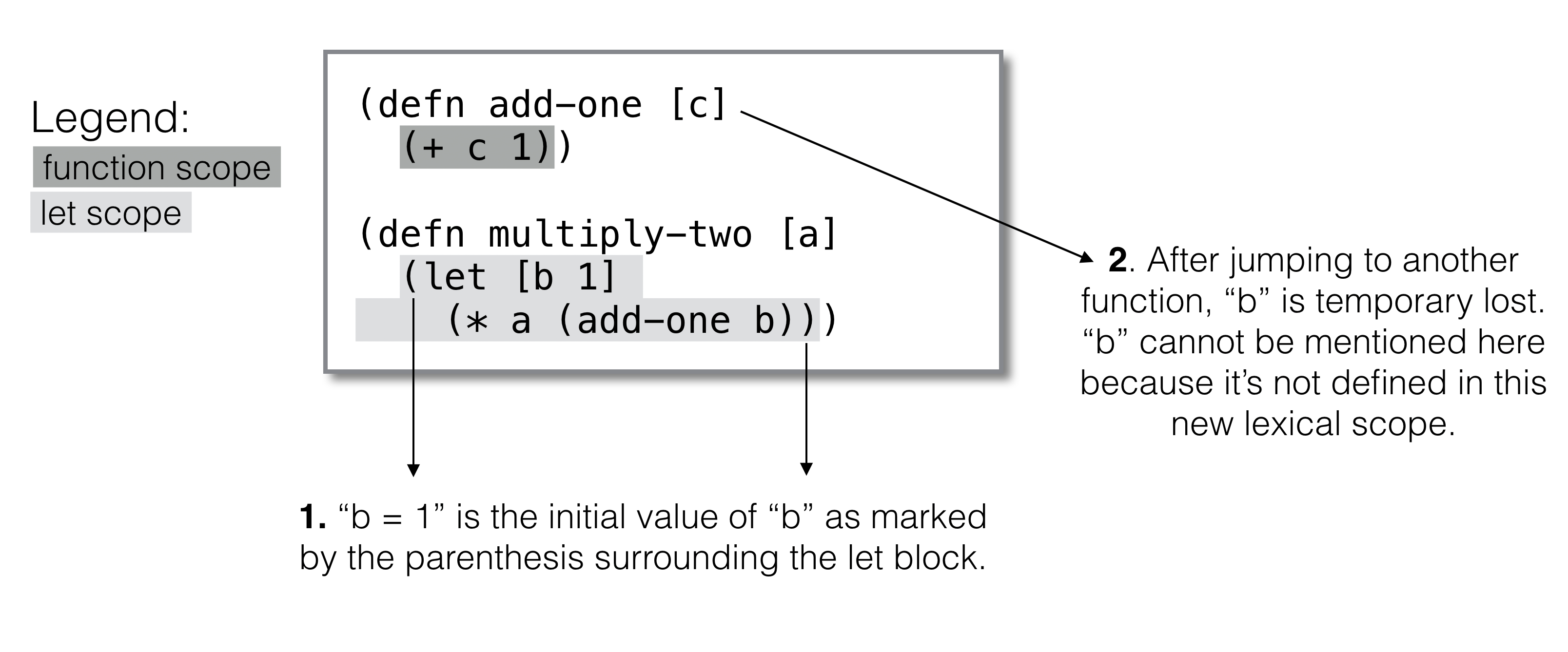
Use the scope diagram to trace where a locally bound symbol is visible and why it cannot be resolved after the enclosing expression ends. section 3.1
