A least frequently used cache evicts the entry with the lowest access count. It suits workloads where recently popular items should survive temporary request spikes better than purely recency-based eviction. section 7.5
Develop an LFU cache by tracking each entry’s frequency and priority:
- Initialize a new entry with counter 1 and record its insertion time for tie-breaking. section 7.5.2
- On a cache hit or update, increment the counter and update the entry’s priority. section 7.5.2
- Use a hash table for constant-time key lookup, while a priority queue identifies the next entry to evict. section 7.5.2
- Prefer newer entries when frequencies tie; with a heap, insertion and updates require logarithmic time, while lookup remains constant-time. section 7.5 section 7.7.3
Why recency alone can fail
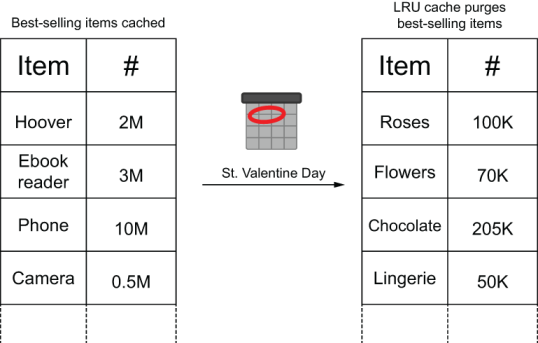
A temporary request peak can fill a cache with newly popular items and displace established best sellers under LRU. LFU is more likely to retain the frequently accessed items, though its slower turnover can preserve an obsolete item for a long time. section 7.5 section 7.5.4
Figure 7.9 An example of a possible situation where LRU eviction policy would purge most “best-selling” items from a cache, in favor of the more recently viewed ones which become popular during a peak of requests. In the figure, items are ordered according to their most recent view; the number of views is shown only to display how most recent views during a peak can wipe out normal best-selling products. While LRU policy never guarantees that best-selling items will stay in the cache, the higher frequency with which they are accessed makes it more likely that they will stay in the cache (because it is likely they will go to the head of the queue before being purged). During a peak, if the number of items that suddenly become popular is large enough, they could fill the cache and force the usual items to be purged. This would be a temporary side effect that will regress after the peak. In some situations, this could also be desirable, because items popular during a peak should be accessed faster than the regular best-selling ones. LRU has a more dynamic turnaround than LFU, as we will see.
Compare a temporary popularity spike with longer-term access frequency and see why LRU and LFU retain different entries. section 7.5
