A ligand is any molecule that binds to a biomolecular target and can change its activity or signaling. Targets include receptors, which act as protein switches, and enzymes. Binding may activate, block, or otherwise regulate the target. section 1.3.1 section 1.4.1
Classify ligands by the effect produced after binding:
- Agonists bind receptors and elicit a response. section 1.4.1
- Antagonists bind receptors without eliciting a response and block agonist binding and cellular signaling. section 1.4.1
- Inhibitors are ligands that reduce target activity; some inhibit enzymes rather than receptors. section 1.4.1
In drug discovery, a ligand is the compound being evaluated against a target. Virtual screening can rank ligands for properties such as binding affinity, solubility, or toxicity, while docking estimates how a ligand may orient inside a target binding pocket. section 1.3.1 section 9.1.1
Drug-discovery examples
Kinase inhibitors illustrate why ligand selectivity matters: similar kinases can cause an inhibitor to affect unintended targets. NSAIDs inhibit COX enzymes to reduce inflammation, whereas SSRIs increase serotonin signaling by blocking its transporter rather than acting as serotonin-receptor agonists. section 1.4.1 section 1.4.1
Figure 1.10 If we know both the structure of our ligand or compound and the target, we can use structured-based design methods. If we only know the ligand structure, we are restricted to ligand-based design methods. Alternatively, if we only know the target structure, we can use de novo design to guide generation of a suitable drug candidate.
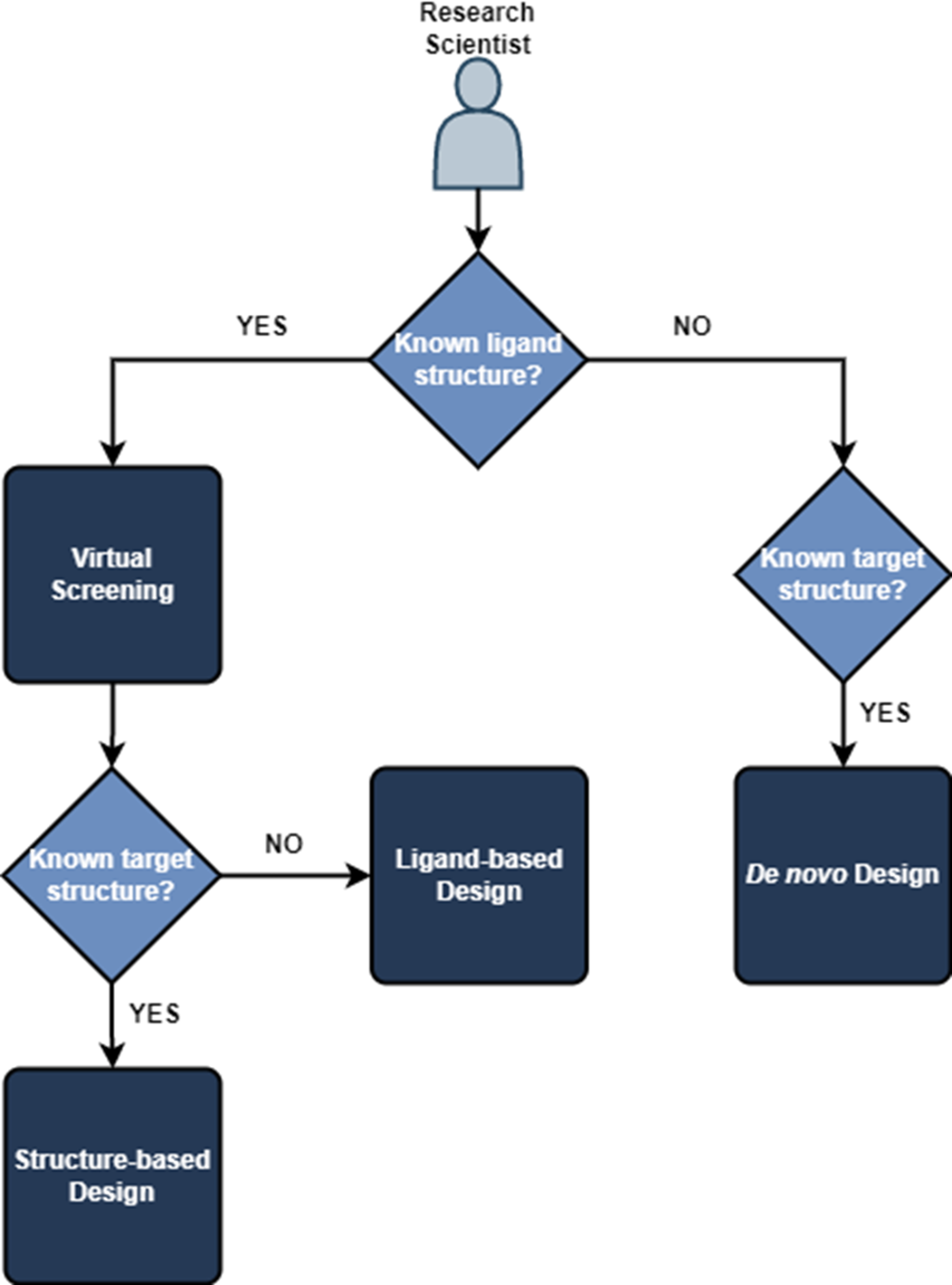
Use the design-method map to choose between structure-based, ligand-based, and de novo approaches according to which ligand and target structures are known. section 1.3.2
