A line equation describes the points belonging to a geometric line. The explicit form y = ax + b is easy to plot and interpret: a controls slope, while b controls the vertical intercept. It cannot represent a strictly vertical line, which requires x = c. section 2.3.1
Choose a representation according to the geometry and dimension:
- Use the general 2D form a₁x + a₂y + a₃ = 0 to represent every line without switching formulas for vertical cases. section 2.3.1
- Use a canonical form with a point and direction coefficients when those geometric ingredients are more useful, especially for later 3D work. section 2.3.1
- Treat ax + by = c as a line in 2D; two such equations form intersecting lines whose common point solves the system. section 3.1.1
- Do not generalize the 2D general form to a 3D line by merely adding z: ax + by + cz = d describes a plane, while a 3D line requires two equations. section 2.3.1
Two-line intersection
The equations Vp − 2Va = 0 and Va + Vp − 450 = 0 represent two lines. Their intersection, (Va, Vp) = (300, 150), is the solution to the system. section 3.1.1
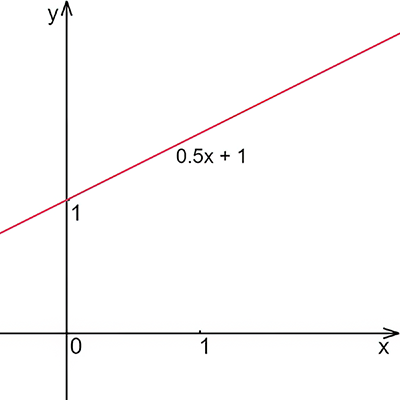
Plot the explicit line y = 0.5x + 1, then compare it with the general and vertical-line cases. section 2.3.1
