When a search stalls, its lineage tree shows where each candidate came from and which branches remain available. In Darwin Gödel Machine (DGM) search, each evolved prompt is an immutable artifact with a pointer to its parent, so the run forms a tree. section 4.4 section 4.3.5
Reading the tree makes the search history useful:
- Follow a candidate's parent links to trace its ancestry. section 4.4 section 4.4.1
- Compare branches and archived candidates; keeping them can let the search recover from a stalled main line. section 4.3.5 section 4.6
- Inspect node scores and parent-relative changes, plus which candidates were available when a champion was bred. section 4.4.1
Recovery from a neglected branch
In one DGM run, the champion grew from a low, structurally different branch that the archive had preserved. The ordinary line had stalled, while a sibling branch produced dead ends; sampling reached back to the neglected branch and continued past the plateau. section 4.3.5 section 4.4.1
Figure 4.14 The Lineage panel tree view over the DGM run, champion selected. Clicking a version lights its ancestry, so the winning line runs genesis to crown while the rest of the archive fades to context, and dashed rings mark the breeding pool at the champion's birth. The champion grew from a branch untouched since the first iteration, its equal-scoring sibling having burned two dead ends in between, and the tree ends at the crown because the run stops the moment ground truth reports a perfect answer.
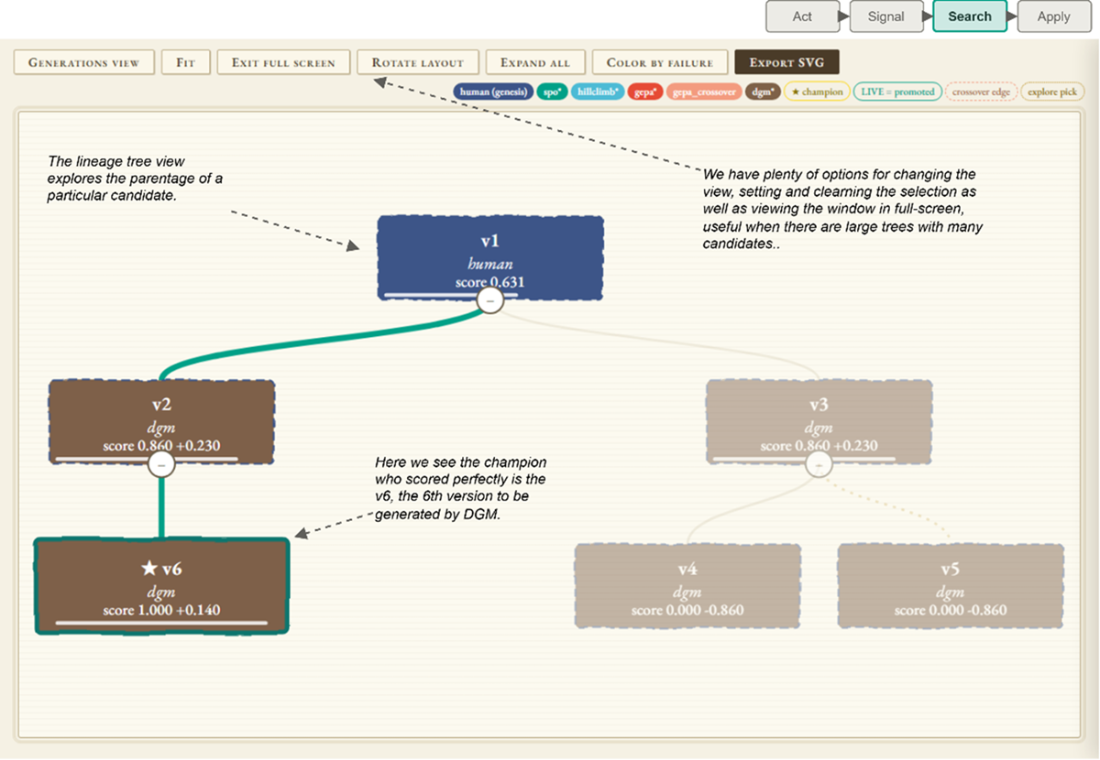
The Lineage panel highlights a selected candidate's ancestry and shows the surrounding archive for context. section 4.4.1