When a value table is impractical because the state space is too large, continuous, noisy, or high-dimensional, linear function approximation represents a state or state–action pair with features and estimates its value as a weighted sum. Learning adjusts the weights to fit evidence. This enables generalization beyond visited states, but introduces representation error and training instability. section 8.1
Calibrating a house-price estimate
For house prices, a linear model uses size to predict price: the intercept sets a baseline, and the weight on size controls how much the estimate changes with each unit of size. Adjusting the weight to reduce prediction errors illustrates parameter fitting; in reinforcement learning, targets depend on current predictions. section 8.1
Figure 8.2 Learning as parameter adjustment: fitting a linear model by turning the θ knobs
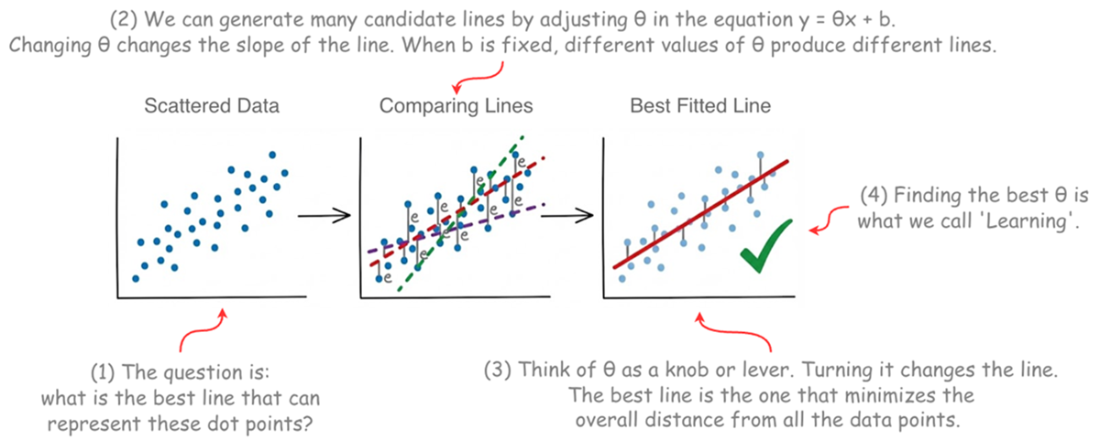
See parameter adjustment as fitting a line to observed points. section 8.1
