A linear model replaces separate state or state–action value entries with a compact, adjustable function. It combines feature descriptions with learned parameters to estimate values across many states, rather than memorizing each one. section 8.1
Choose a model to match the input representation:
- Use linear models when you can engineer interpretable features. section 8.6
- Use deep networks for raw, high-dimensional inputs such as images or sensor data. section 8.6
Why approximate values?
Radiotherapy planning illustrates why tabular storage becomes impractical when realistic state spaces cannot be explicitly enumerated. section 8.1
Figure 8.2 Learning as parameter adjustment: fitting a linear model by turning the θ knobs
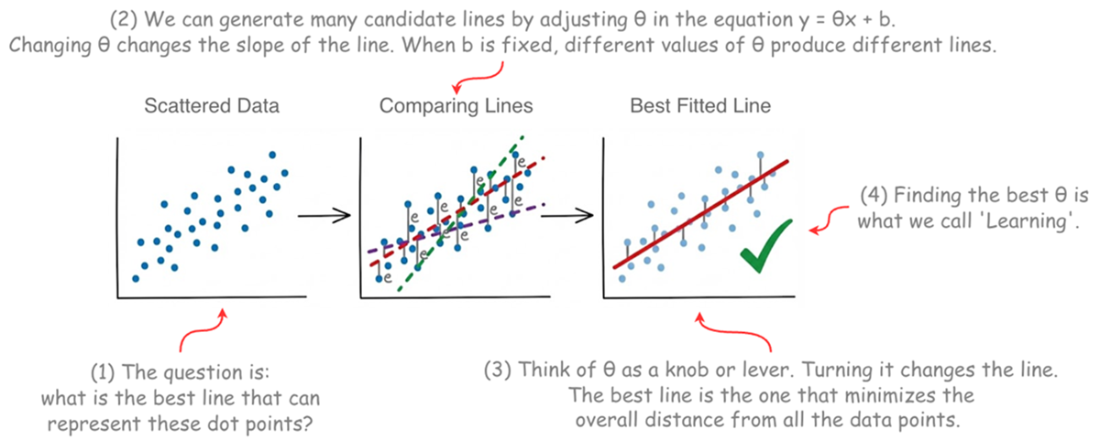
The parameter-adjustment diagram presents learning as turning model parameters rather than filling separate table entries. section 8.1
