Projection maps a point to the closest point on a line, plane, segment, or other geometric object. The connecting vector meets the object at a right angle, making projection a practical way to reduce distance and reason about position. section 3.3.1 section 10.1.3
Projection also explains the geometric meaning of the dot product. When vector a has unit length, a · b gives the length of b projected onto a; for arbitrary lengths, a · b = ‖a‖‖b‖cosθ. section 9.2.1
For computational geometry, projection supports several useful decisions:
- Projecting alternately onto two intersecting lines moves an initial point toward their intersection, the solution of the corresponding equations. section 3.3.1
- Projecting a point onto a segment requires checking whether the normalized projection lies before the first endpoint, between endpoints, or beyond the second endpoint. section 10.1.4
- A projection inside a triangle identifies the point-to-plane distance as the triangle distance; otherwise, compare the nearest edge or vertex. section 10.1.3
Projection in a signed distance function
A rectangle signed-distance implementation projects an input point onto each edge. If the projection falls within an edge, it uses the point-to-line distance; if it falls outside, it uses the nearer endpoint distance, then applies the line-derived sign. section 10.1.4
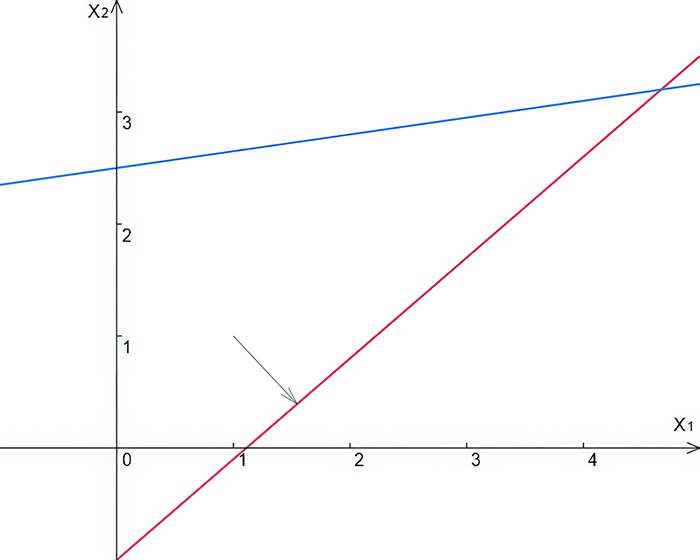
A geometric figure shows the perpendicular drop from a point to a line, making closest-point projection immediately visible. section 3.3.1





