Linearizability is a strong consistency property that makes replicated data appear to have one authoritative copy. Each operation has one effect, and later operations observe the resulting state. It applies to individual operations on a single object, unlike serializability, which governs multiple operations across one or more objects. section 4.3.1
A linearizable key–value store
Consider three replicas. put(A, 1) establishes A = 1 everywhere; put(B, 2) adds B = 2; put(A, 3) changes A to 3 while retaining B = 2. After each completed operation, every replica represents the same state, so a request sent to another replica sees the acknowledged update. section 4.3.1 section 4.6
Use linearizability when the application needs:
- A simple consistency model in which operations behave as though they access one copy of the data. section 4.3.1
- Persistent acknowledged updates that remain visible after component failures. section 4.6
- A deliberate latency trade-off: linearizability can be expensive, and weaker models may suffice for some workloads. section 4.3.1 section 4.9
Figure 4.1 An example of a linearizable key–value store with three replicas. Each of the replicas is in the same state after every operation because linearizability gives the illusion of a single copy of data being accessed and updated.
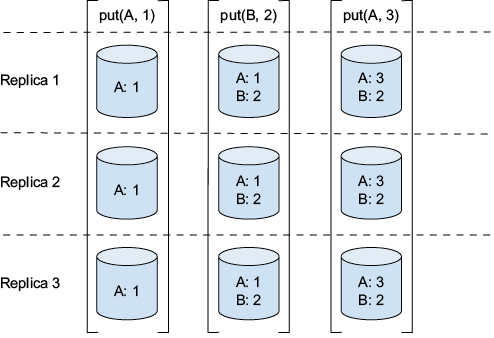
Inspect the three-replica sequence to see how every completed operation leaves replicas in the same state. section 4.3.1



