Two classes are linearly separable when a linear decision boundary divides their training observations without error. In one dimension, that boundary is a threshold. section 8.1.1
Separability establishes that a perfect boundary exists; it does not choose among multiple boundaries. A maximum-margin SVM selects the boundary farthest from the nearest observation in each class. section 8.1.1 section 8.1
Safe and unsafe temperatures
Plot manufacturing temperatures on a number line and label readings safe or unsafe. A threshold between the classes separates the observations when none fall on the wrong side. section 8.1.1
Figure 8.1 Temperature readings appear along a single horizontal axis, increasing from left to right. Circles represent safe conditions, and squares represent unsafe conditions. The vertical dashed line is the decision boundary. The nearest observation on each side is a support vector, and the distance between the boundary and these points defines the margin on either side. Positioning the boundary midway between the support vectors produces the maximum-margin separator.
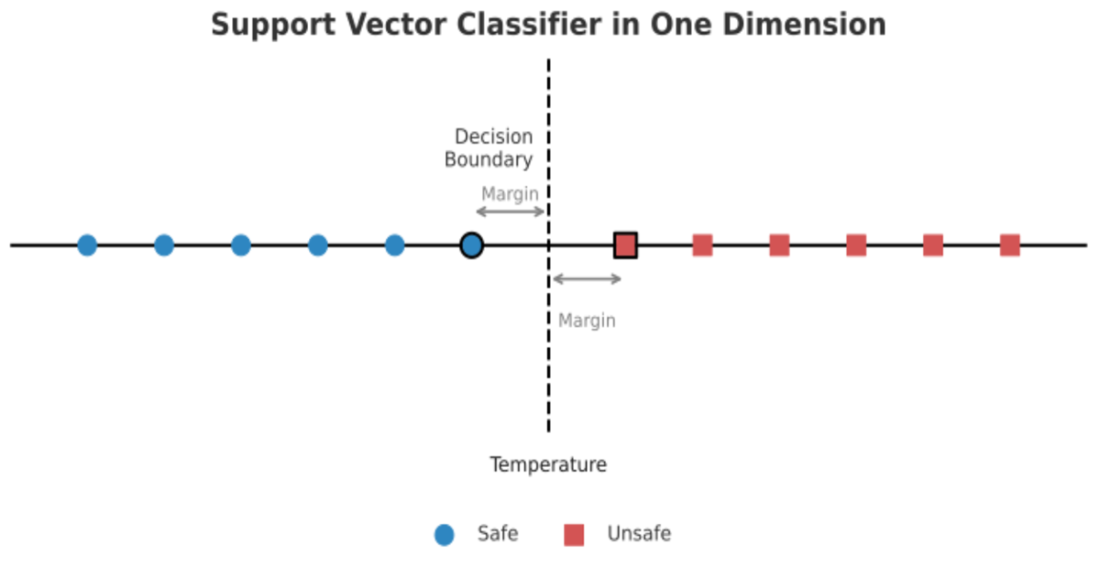
The figure shows the threshold, nearest observations, and margin in the temperature example. section 8.1.1



