A link prediction feature encodes evidence that a relationship may form between two nodes. It can represent similarity, network distance, or overlap between their local or global neighborhoods. section 10.6
Common ways to construct link prediction features include:
- Aggregating properties of the two nodes. section 10.6
- Encoding network distance, where closer nodes are treated as more likely to connect. section 10.6
- Measuring neighborhood overlap with common-neighbor counts, Jaccard similarity, or Adamic-Adar. section 10.1 section 10.6
After calculating features for node pairs, rank the highest-scoring pairs or train a classification model. A model can learn that some metrics or metric combinations matter more than others. Keep feature, training, and test relationships separate to avoid leakage, and subsample negative examples to reduce class imbalance. section 10.1 section 10.6
Recommending Twitch channels
For channel recommendations, shared audiences provide relationship evidence between channels. Neighborhood and other link prediction features can then support ranking recommendations or training a model to forecast future channel connections. section 10.1
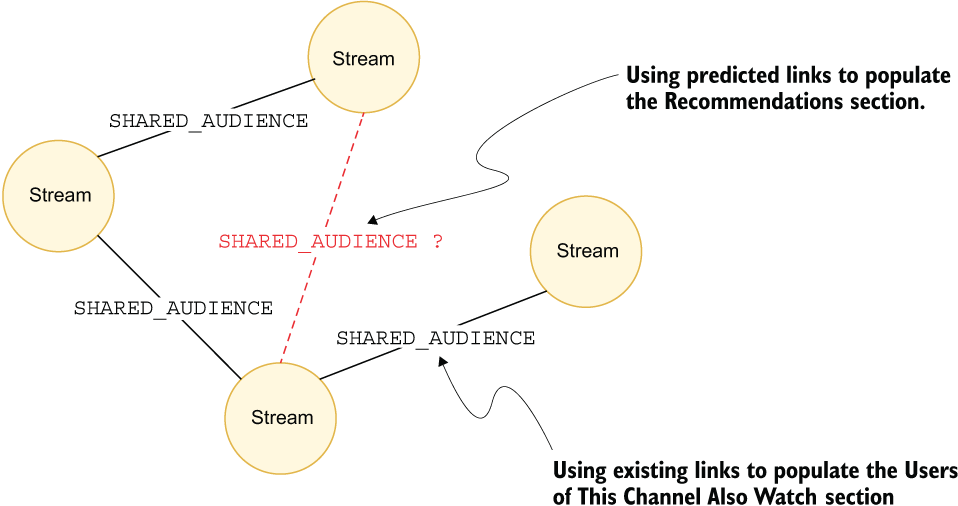
Use the link prediction flow to connect pair encoding, feature calculation, prediction, and evaluation. section 10.1
