A lint rule is an executable static-analysis condition that turns implicit engineering knowledge into a build-failing check. Lint-as-architecture prevents agents and developers from repeating violations that humans previously caught through onboarding or review. section 10.5.1
Use a disciplined feedback loop rather than adding rules indiscriminately:
- Trace an incident to a repeatable architectural violation. section 10.5.1
- Fix the immediate defect, codify the review criterion, and add a lint rule or architectural check. section 10.5.1
- Start conservatively, measure unmodified approvals and escapes, promote reliable patterns, and recalibrate monthly. section 10.5.3
- Treat avoided review time as released capacity, then measure what that capacity produces instead of calling it realized savings. section 10.5.3
From architectural failure to permanent guardrail
If an API layer calls the database directly, fix the pull request and encode the boundary as a lint rule. The same pattern applies to missing endpoint authentication checks and service-to-service HTTP calls that should use a message queue. One team grew from 23 rules after two months to 67 after six months, projecting about 200 after a year. section 10.5.1
Figure 10.6 Bug → Codify → Lint Rule.
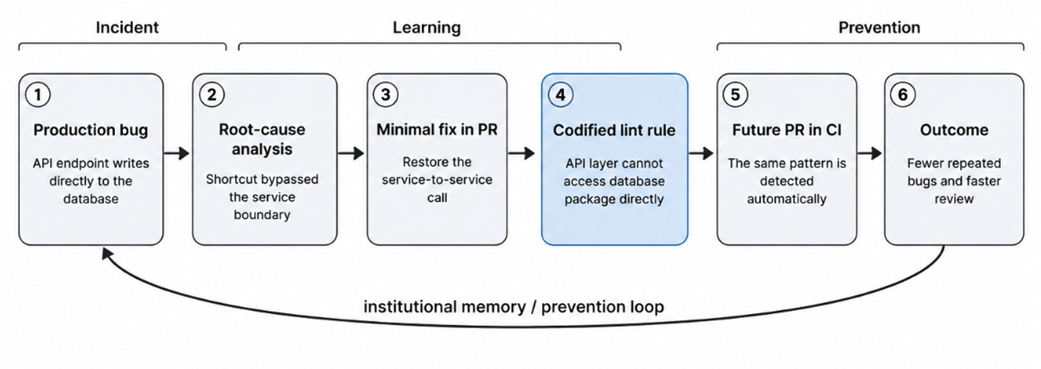
Use the Bug → Codify → Lint Rule figure to navigate the rule-creation loop. section 10.5.1
