The listening state is a transitional Spanning Tree Protocol (STP) port state. A newly enabled port enters it to exchange Bridge Protocol Data Units (BPDUs) and determine whether it becomes a root, designated, or non-designated port. It neither forwards regular data frames nor learns MAC addresses. section 14.4.1
Track the listening state through the STP transition:
- A non-designated port moves immediately to blocking, where it continues listening for BPDUs but does not forward frames. section 14.4.1
- A root or designated port remains listening for the 15-second default forward delay, then enters learning. section 14.4.2
- The port must pass through listening and learning before forwarding, preventing a newly enabled connection from creating a Layer 2 loop. section 14.4.1 section 14.4.2
Checking a port in listening
After reenabling SW2’s interface, use `show spanning-tree`. In output such as `Gi0/1 Root LIS`, `LIS` identifies the listening state. The interface can send and receive BPDUs, but it cannot forward ordinary traffic or learn source MAC addresses. PortFast can bypass listening and learning for end-host ports, but connecting a switch to a PortFast-enabled port can create a Layer 2 loop. section 14.4.1 section 14.5.1
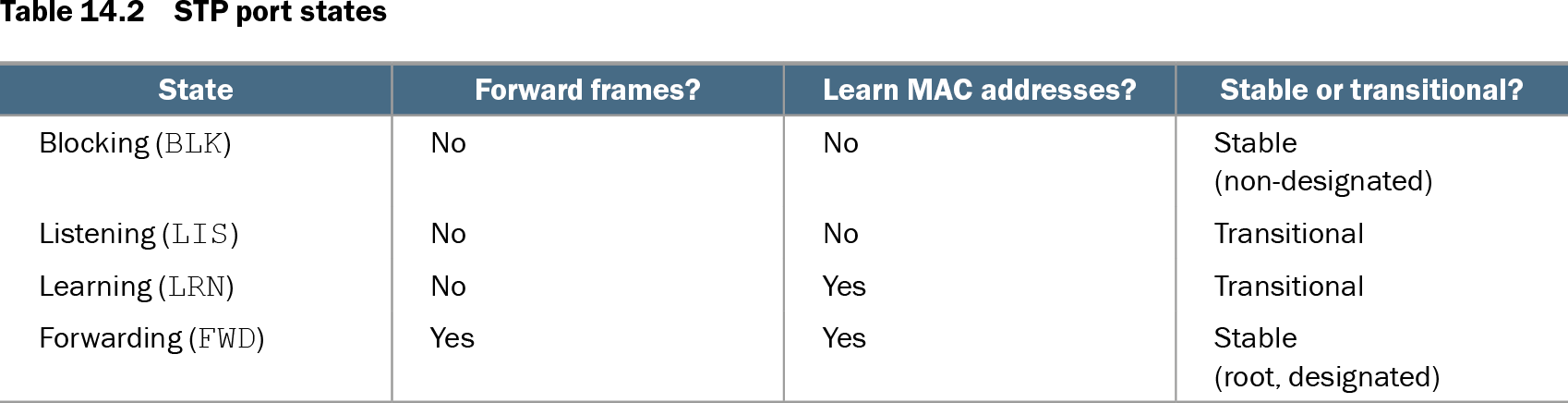
Table 14.2 STP port states (view table figure)
| State |
Forward frames? |
Learn MAC addresses? |
Stable or transitional? |
|---|---|---|---|
| Blocking (BLK) |
No |
No |
Stable (non-designated) |
| Listening (LIS) |
No |
No |
Transitional |
| Learning (LRN) |
No |
Yes |
Transitional |
| Forwarding (FWD) |
Yes |
Yes |
Stable (root, designated) |
Compare listening with blocking, learning, and forwarding by frame forwarding, MAC learning, and transition stability. section 14.4.1