Living documentation keeps models, decisions, designs, and thought processes aligned with new information. It changes through feedback loops rather than remaining a finished record. section 11.3 section 11.3.1
Use living documentation to keep collaborative design responsive:
- Review and adjust models collectively after each modeling iteration or walkthrough. section 11.3.1
- Add information discovered through techniques such as Big Picture EventStorming, process EventStorming, or Example Mapping. section 11.3.1
- Separate increasingly large online whiteboards by bounded context or concern when one board becomes difficult to manage. section 11.3.1
- Keep decisions transparent by maintaining ADRs and enabling asynchronous comments from absent stakeholders and experts. section 11.7
From one board to an evolving map
A team may begin with one Miro board containing EventStorming, context maps, Pros-Cons-and-Fixes lists, and polarity maps. As new feedback accumulates, it can split the material across bounded-context boards and connect the evolving decisions through ADRs. section 11.3.1
Figure 11.7 Model Exploration Whirlpool from Eric Evans. This whirlpool helps in considering collaborative modeling as a collection of feedback loops, rather than a linear process. (Source: www.domainlanguage.com/ddd/whirlpool/)
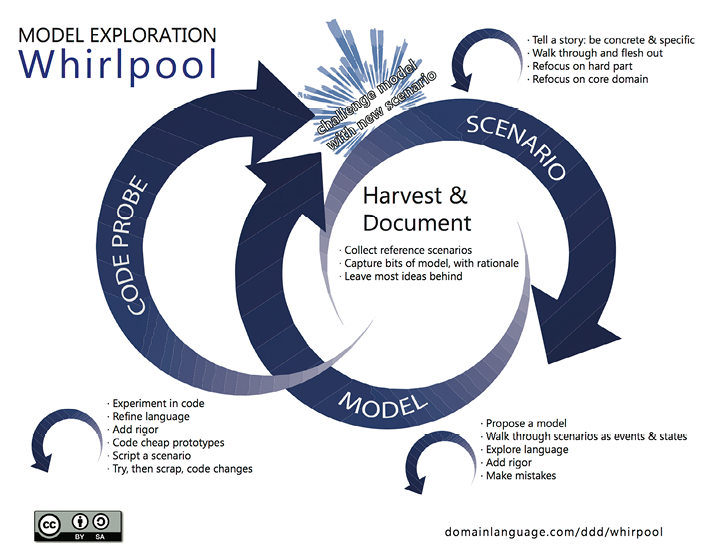
Use the Model Exploration Whirlpool to frame collaborative modeling as recurring feedback loops instead of a linear process. section 11.3.1


