LLMOps is the engineering discipline of running large language models reliably in production. A support assistant may pass internal tests yet give inconsistent answers and generate a $47,000 monthly bill once real users arrive. Its behavior depends on prompts, context, user phrasing, load, and model updates; an apparently healthy service can still produce wrong answers or leak sensitive information. section 10.0 section 10.1
LLMOps draws on DevOps and MLOps but shifts attention toward prompt management, retrieval-augmented generation evaluation, and usage and cost monitoring. Uptime and latency remain useful, but they cannot establish whether responses are good, safe, or helpful. section 10.1
A production system connects five layers:
- Input processing validates requests, routes them, and builds context. section 10.1
- Model execution manages hosted APIs or self-hosted models and retrieval through vector databases. section 10.1
- Output processing evaluates responses, applies safety checks, and formats results. section 10.1
- Monitoring tracks performance, response quality, and user satisfaction. section 10.1
- Continuous improvement uses those measurements for A/B testing, prompt optimization, and model updates. section 10.1
Deployment choices trade speed and capability against control and complexity. Hosted APIs enable rapid deployment but limit cost control and data privacy; self-hosting provides more control but adds infrastructure work. A hybrid architecture can route simple queries to economical local models, reserve premium APIs for complex requests, and use fallbacks when needed. Monitor tokens, cost per interaction, quality scores, ratings, session patterns, and escalations; set alerts for runaway spending. Maintain quality through prompt and input controls, automated detection, and systematic correction, supported by prompt versioning, shadow testing, and continuous evaluation. section 10.7
Figure 10.1 Complete LLMOps architecture for production AI systems
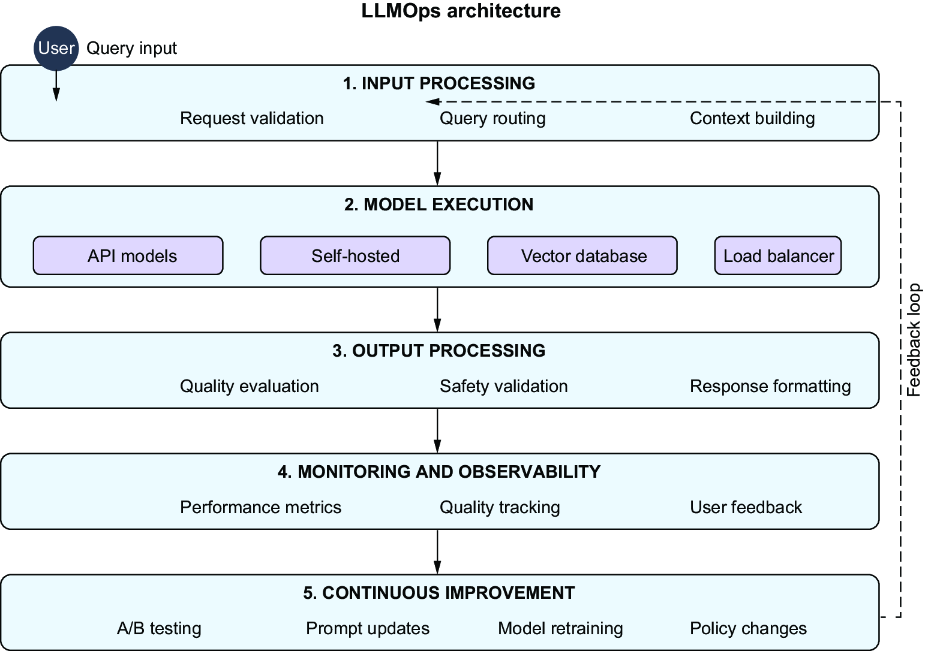
The architecture diagram shows the five layers and the feedback loop from monitoring to improvement. section 10.1





