A log-likelihood function is the logarithm of the likelihood of observed data, evaluated as model parameters change. It provides an objective for fitting probabilistic models. section 5.6.1 section 8.9.1
In Gaussian mixture modeling, expectation-maximization repeatedly updates each Gaussian’s covariance, mean, and density using the probability that each point came from that Gaussian. The process continues until convergence, stopping when the log-likelihood is maximized; the proofs are beyond scope, while implementation is more straightforward. section 5.6.1
Log-likelihood also guides generative neural-network training:
- Optimizes the probability of observed data under a deep belief network’s generative model. section 8.9.1
- Uses contrastive divergence to approximate the gradient of log-likelihood for each restricted Boltzmann machine layer. section 8.9.1
- Supports layer-wise pretraining, allowing successive layers to learn increasingly abstract features without labeled data. section 8.9.1
Gaussian mixture fitting
Assign each data point a probability of belonging to Gaussian j, use those probabilities to update the Gaussian parameters, and repeat until the log-likelihood reaches its maximum. section 5.6.1
(5.10)
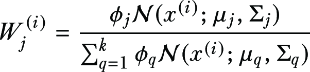
Inspect the supplied equations for the Gaussian mixture likelihood and its parameter updates, including covariance, mean, and density. section 5.6.1


