A log-likelihood ratio (LLR) compares how plausible a protein model finds a mutation with the original, or wild-type, amino acid. It is the logarithm of the mutant probability divided by the wild-type probability, given the surrounding sequence. section 12.3.5
To score a mutation, mask its position in the protein sequence and ask a pretrained model for the probabilities of both amino acids. Subtract the log probability of the wild type from that of the mutant. A positive score means the model favors the mutant; a negative score means it favors the wild type. section 12.3.5
The score compares the mutant m and wild type w in the same sequence context. section 12.3.5
Scoring a substitution
To assess a change from alanine to cysteine at position 42, mask that position and compare the model’s predicted probabilities for cysteine and alanine. The resulting score can help prioritize the variant for experimental testing. section 12.3.5
Scoring many substitutions produces a mutation landscape that can reveal positions where changes appear more or less tolerable. LLRs often correlate with experimental measurements of mutation effects, but model plausibility is not itself an experimental result. section 12.3.5 section 12.4
Figure 12.12 A zero-shot mutation landscape predicted by ESM-2. The x-axis represents the residue position, and the y-axis represents the 20 possible AA mutations. The color indicates the Log-Likelihood Ratio (LLR): brown regions indicate deleterious mutations that the model views as evolutionarily unlikely, while white/blue regions indicate neutral or beneficial mutations.
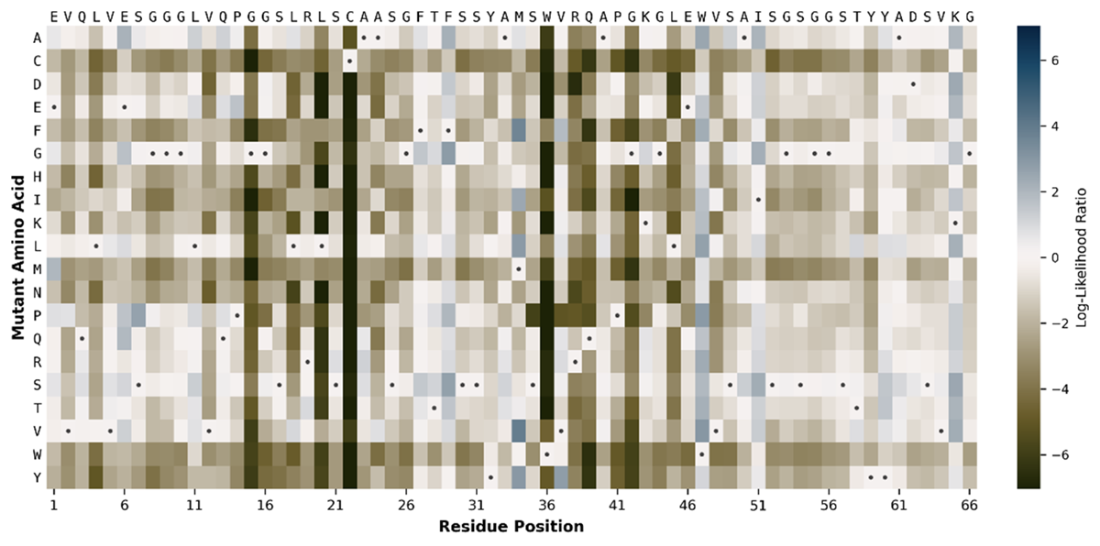
This landscape displays predicted scores across positions and possible amino acid substitutions. section 12.3.5

