A logical architecture organizes error-corrected quantum computation. It specifies the error-correction code, logical-qubit connectivity, and operations available to logical qubits. Logical qubits encode information across multiple physical qubits, while logical gates become sequences of physical gates and measurements. section 9.3
Account for these architectural constraints when estimating a quantum program’s performance:
- Error correction reduces physical error rates but adds substantial overhead: one logical gate may require dozens or hundreds of physical gates and measurements. section 9.3
- The software stack transforms arbitrary program gates, including rotations and multicontrolled gates, into supported logical operations. section 9.3
- Limited logical-qubit connectivity can prevent direct interactions between distant qubits, requiring sequences of operations on adjacent qubits. section 9.3
- Auxiliary qubits can support routing and other transformations alongside the data qubits carrying the computation. section 9.3
Estimating a fault-tolerant implementation
A program that applies a gate between distant logical qubits cannot assume direct execution. The software stack must decompose the gate into supported operations, route interactions through neighboring qubits, and account for the added gates, measurements, execution time, and qubit requirements. section 9.3 section 9.8
Figure 9.5 Physical qubits are noisy, they support a limited set of gates, and these gates are slow. We have to use error correction to enable reliable computation on noisy qubits. We also have to use a special process to implement arbitrary logical gates on logical qubits. These factors affect both the run time of algorithms on the quantum computers and the numbers of qubits required to run them.
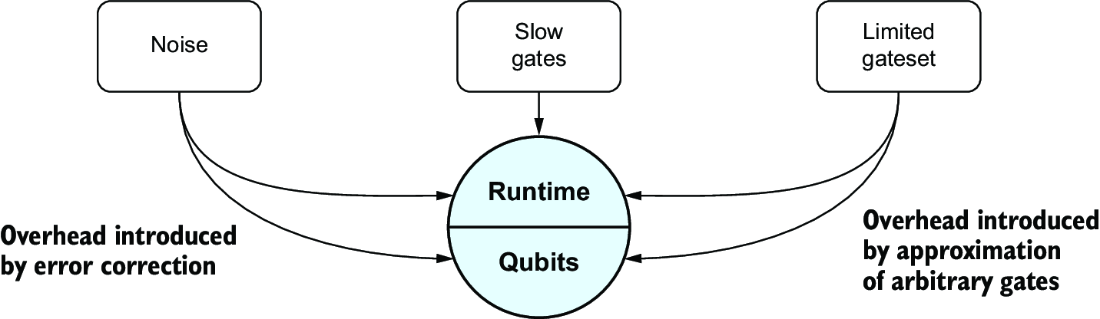
Use the figure to trace how noisy physical qubits, restricted gates, error correction, and logical-gate implementation jointly affect runtime and qubit counts. section 9.3
