A logical gate is an error-corrected quantum operation acting on one or more logical qubits. Logical qubits encode information across multiple noisy physical qubits so computation can remain reliable. section 9.3
Logical gates address the limits of physical hardware: physical gates are slow, noisy, and available only from a restricted set. Implementing arbitrary logical gates requires a special process, adding runtime and qubit overhead to quantum algorithms. section 9.3
Figure 9.5 Physical qubits are noisy, they support a limited set of gates, and these gates are slow. We have to use error correction to enable reliable computation on noisy qubits. We also have to use a special process to implement arbitrary logical gates on logical qubits. These factors affect both the run time of algorithms on the quantum computers and the numbers of qubits required to run them.
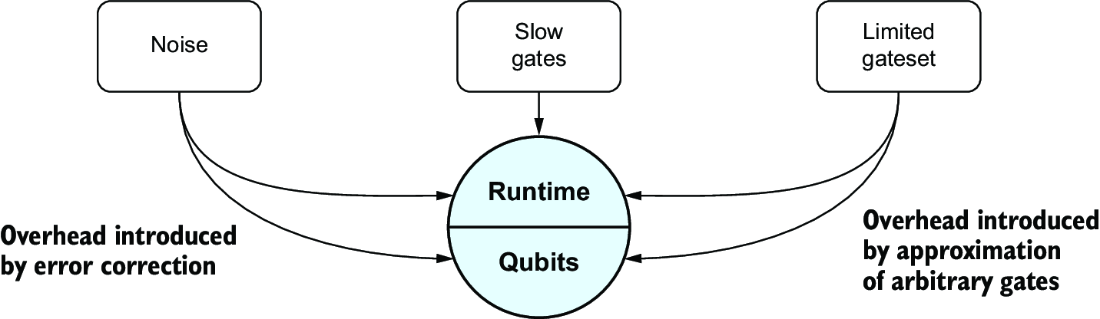
Compare noisy physical qubits, error correction, and the additional process required to implement arbitrary logical gates. section 9.3
