The London school is a unit-testing approach that isolates the unit under test from its collaborators. A class is treated as the unit, and mutable dependencies are replaced with test doubles so the class can be verified separately from external influence. section 2.1 section 2.5
Its defining choices are:
- Isolate units rather than merely isolating tests from one another. section 2.2
- Treat a class as the unit under test. section 2.2
- Replace all mutable dependencies with test doubles, while retaining immutable values such as enums and numbers. section 2.2
- Prefer communication-based testing, using mocks to verify interactions with collaborators. section 6.6
Customer purchase with a mocked store
A purchase test creates a mock IStore, configures HasEnoughInventory(Product.Shampoo, 5) to return true, and verifies that RemoveInventory(Product.Shampoo, 5) occurs once. A failure case returns false and verifies that removal never occurs. The real Product value remains because it is immutable. section 2.1 section 2.2
Figure 2.1. Replacing the dependencies of the system under test with test doubles allows you to focus on verifying the system under test exclusively, as well as split the otherwise large interconnected object graph.
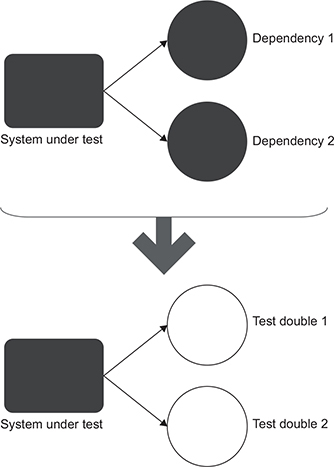
Use the figure to see how replacing collaborators with test doubles reduces an interconnected object graph to the system under test and its focused tests. section 2.1
The approach offers fine-grained tests, easier testing of interconnected classes, and clearer fault localization after failure. Its main cost is over-specification: mocks can couple tests to implementation details, reduce resistance to refactoring, and make tests fragile. Communication checks are strongest when they cross an application boundary and have externally visible side effects. section 2.3 section 5.4 section 6.6
