liveBook · Manning

Long-term planning

As explained in Applied Reinforcement Learning

Planning that evaluates how present actions affect outcomes over an extended sequence of future decisions.

Long-term planning weighs how present actions affect outcomes across future decisions. In reinforcement learning, an agent observes a state, acts, receives a reward, and moves to a new state; repeated interactions help it learn a policy that maximizes long-term reward, even when feedback is delayed. section 1.7

Figure 1.7 Overview of reinforcement learning framework.
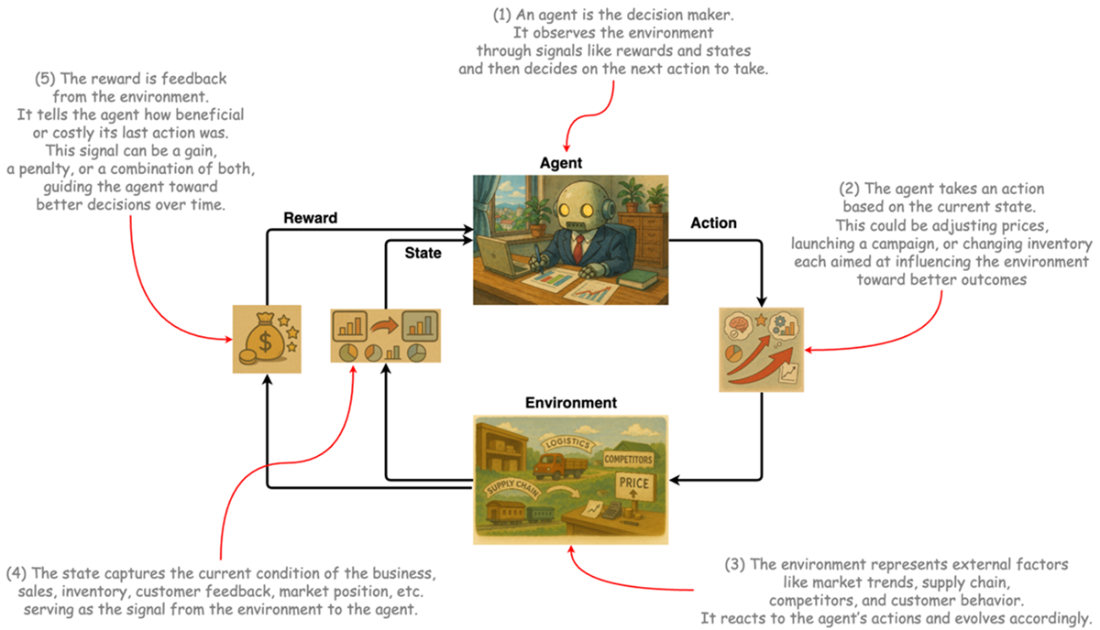
The interaction loop shows how actions, rewards, and state transitions support learning a policy over time. section 1.7

How Applied Reinforcement Learning covers it

How deep it goes
Connects sequential decisions, delayed consequences, trade-offs, and policy learning at a conceptual level.
Examples
Uses inventory management and personalized recommendations as business application contexts.
What you can do after
Understand how repeated interaction helps an agent learn a policy that maximizes long-term reward.
How it connects
Links long-term planning to reinforcement learning, states, actions, rewards, transitions, and policies.

Related concepts

This explainer was generated by Manning's knowledge graph from the text of Applied Reinforcement Learning. The section links point to the parts of the book it draws on.